5/09/2012

How Many Single Family Homes Under $300,000 in Long Beach?

Since this Spring of last year, the last time I wrote this post, not as many as last year.

The great majority of residential properties included here are single family houses and condominiums; the list also includes lofts (a separate MLS designation), own-your-owns and co-ops. The grand total from SoCalMLS is 340 listed as "active", regardless of selling condition (short sale, REO, probate, etc.), or the amount of HOA dues in the case of common area properties.

This inventory is quite different from one year ago when there were a total of 618  on the market.

The breakdown includes the following:

5/08/2012

Increase in April Home Sales Prices for Long Beach, and Nearby Cities

Based on MLS data, 10K Research&Marketing
Long Beach home sellers may finally take heart at some continuing good news. While the citywide accumulated median and average price for single family home sales continues to decline from last year, the April 2012 comparison to the same time last year actually shows an increase in median and average sales price:  Median - from $374,500 to $381,000;  Average - from $421,796 to $424,441.

The average price from April 2011-April 2012 for condos and townhomes also shows a 10% increase, from $211,280 to $232,676. 

As above, the "rolling" 12-month calculation for both categories still shows a decrease in prices, however.  With the increase shown in pending sales compared to last year, more buyers are buying. But the 50% cut in inventory levels say that many possible sellers have yet to decide to put their properties on the market.  In fact, Long Beach had the highest number of closed sales (226) in April over all the other 60+ cities in this report area.

4/27/2012

6 Don’ts After You Apply For A Mortgage

I learned a long time ago that “common sense is NOT common practice“. This is especially the case during the emotional time that surrounds buying a home, when people tend to do some non-commonsensical things. Here are a few that I’ve seen over the years that have delayed (and even killed) deals:
  1. Don’t deposit cash into your bank accounts. Lenders need to source your money and cash is not really traceable. Small, explainable deposits are fine, but getting $10,000 from your parents as a gift in cash is not. Discuss the proper way to track your assets with your loan officer.
  2. Don’t make any large purchases like a new car or a bunch of new furniture. New debt comes with it, including new monthly obligations. New obligations create new qualifications. People with new debt have higher ratios…higher ratios make for riskier loans…and sometimes qualified borrowers are no longer qualifying.

4/16/2012

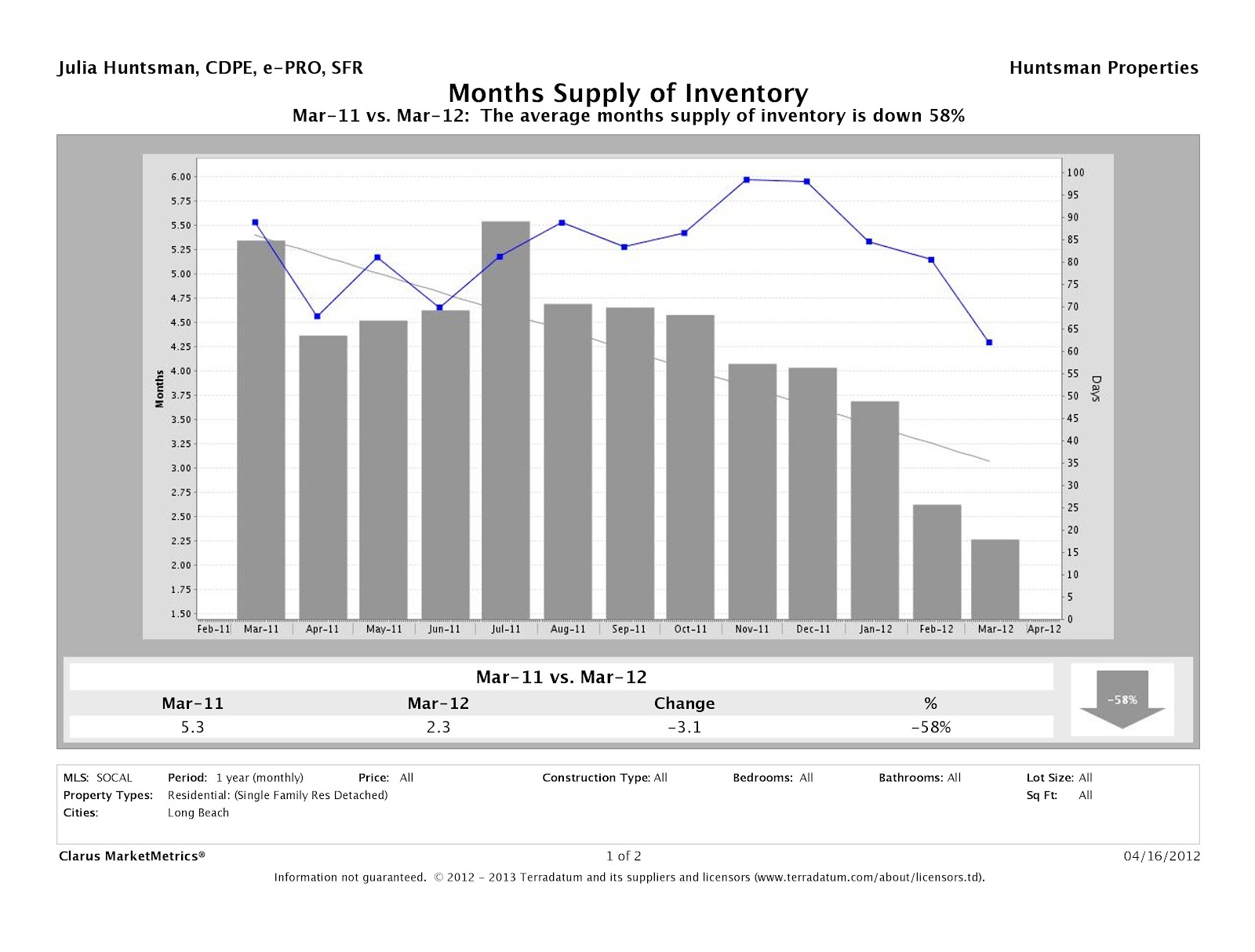
Long Beach Needs More Single Family Homes on the Market!

Long Beach Inventory
Long Beach--two months inventory
For the last year, since March 2011, the Long Beach median prices have been jumping around.  The median prices for listings and sales have gone up and down for the city, overall. These charts show the overall market, which varies in price quite a bit, and lumps all distressed properties in with regular sales.  In March of last year, the median price was $365,000, and for March of 2012, the price is $369,900--while the "sold" prices have actually gone down. But what is in escrow? That's where the prices in 1-3 months may be showing an upward trend, because sales activity has picked up a much faster pace:  the number of single family properties (both distressed and regular sales) in escrow is up 40%, and is at the highest number in the last 12 months.

Long Beach Median Price march 2012
Median price for listings is up again in Long Beach
And another thing is very clear: in checking with Long Beach, Lakewood and Cerritos, all cities are down to two months or less of inventory for single family houses. The second chart clearly shows a downward trend in numbers of listings on the market since last summer.

That means if no new listings came on the market, the current inventory would be sold in approximately 2 months at the current rate of sale.
Sellers should start contacting their real estate professional now to review their best position for selling, because the buyers, both investor and owner-occupant types, are buying!

I am available to help you as your real estate professional, just give me a call, e-mail me, or contact me through my website at www.juliahuntsman.com.

4/12/2012

California Foreclosure Study by San Francisco Assessor

This information just came in this afternoon to me from Duane Gomer, a real estate trainer active in the real estate market:
The San Francisco Assessor commissioned a foreclosure study during 2009 and 2011. The results are revealing and stunning to me and I’ve studied this market for decades. For example: 1 – 99% had irregularities, 2 – 84% had violation of law, 3 – 75% had issues with the assignments of the trust deeds, 4 – 84% had problems with the substitution of trustees, 5 – 59% had evidence of backdating, 6 – 45% the foreclosing party had never been assigned the loan. The Assessor’s conclusion: The California Non-Judicial Foreclosure System is “utterly broken” and needs repair.
Just as further comment, the California non-judicial foreclosure law and procedures is explicitly spelled out in California code. 

This study of 382 San Francisco homes between 2009 and 2011 was conducted by a Newport Beach-based company, and a February 2012 Orange County Register article goes into more detail here.

3/27/2012

Number of FHA Qualified HOAs Falling Drastically

This afternoon I was sent a list of FHA-approved condominium complexes for Long Beach.  They now currently number 34, with two approvals expiring in April, leaving 32 for all of Long Beach.  This is a huge reduction in number compared to a few years ago--these approvals are dropping off for two reasons: HOAs don't realize the requirements have changed or that their approval has expired and that they must renew again, or the HOA complex's financial circumstances don't currently meet FHA guidelines.  But I believe many complexes fall into the first category.

If you are an HOA member, or know someone who is, think about this: If your complex is not approved for FHA-HUD loans, you greatly reduce the number of approved buyers who can bring an offer, thus probably delaying the selling date of your property.

If you are a buyer with an FHA approved loan (especially one being used with certain buyer assistance programs), your selection is now greatly reduced because you simply will not be able to buy in a non-FHA approved condominium complex.

Property owners, you should take active steps to look into this issue.  With today's loan qualifying requirements, FHA loans are accessible for many 1st time and repeat buyers, and in the future they will become even more critical as former owners of distressed properties re-enter the market.

So you think you're going to keep living there, and it doesn't matter?  What if you would like to get a reverse mortgage?  They require your complex to be FHA approved.

Yes, there are lenders willing to qualify your association during escrow, but don't wait until then--it's a much longer process, and the buyer could decide to find another property.

Or the alternative is, if you're a buyer, be prepared to use a lender not of your choice, but one of the few who can give you a similar loan without needing to go FHA. In that case, call me, and I can send you to the right place.

But owners, remember, there are still FHA approvals required for reverse mortgages, therefore contacting your Board of Directors should be at the top of your agenda.

3/26/2012

Positive News in the Long Beach House Market

LB market up in some areas
While it's certainly not true everywhere, the coastal area news is surprisingly up!

Comparing February 2011 to February 2012 in 90803 zip code, there's a huge increase in sales prices! and a huge decrease in the listing supply, and a (huge) increase in pending and closed sales.  Average sales and median prices comparing the two February periods increased by 63% and 41%!

And when comparing the average 90803 sales price over the entire year period, the average sales price increased from $717,997 to $724.188.

This exact same price scenario is not true in all areas, however, but in general it is true throughout Southern California and elsewhere that sales activity has increased greatly, and listing inventory has decreased.

In the 90807 area (Bixby Knolls, California Heights, etc.), the median and average sales prices have increased for the February year comparison period by 16 and 17%, but is down 5-7% when looking at the entire last 12 month period, wtih a 20% increase in closed sales. Again, listing inventory is down by 37%.

Low interest rates are helping to fuel the march towards more buyers finally getting into the act of buying.

If you know of someone thinking of selling, is now the time to start making that move?

For a similar report for your area in Long Beach, Lakewood, Cerritos, Bellflower, San Pedro, Cypress, Seal Beach, Huntington Beach and many other cities in Los Angeles and Orange Counties, just contact me via e-mail or phone!

See more news: Local Regional Market Report--March 2012 -- and check out the 1-Minute Newsletter tab above.

3/22/2012

The 5 Best Home Improvements Projects in Southern California

It's should be no surprise that costs have gone up, but important to know is that the 9-year trend shows a downward cost-value ratio. But still, the Pacific Region in the 2011-2012 Cost vs. Value Report states, "In Pacific Region markets, the high cost of remodeling is more than offset by high values at resale, giving it the highest average cost-value ratio (71.3%) in the country."  And, overall, the report puts the top 10 projects nationwide as giving a value between 69-78%. 
Remodeling Magazine: Regional Comparison
Sellers, at this point, please take note that 1) because you put in a $40,000 bathroom remodel doesn't mean the value of your house went up $40,000, and 2) taking care of deferred maintenance projects, unless a large remodel/upgrade is the replacement, does not add a higher price tag to your home.

And, keep in mind that a low-cost re-do of $3000-$4000 can often be enough to prepare a property for sale, i.e., low-cost kitchen fix-up, vs. spending $19,000+.

Nationally, siding, window and door replacement projects were in the top 10, because certain costs have actually decreased, and also because they are under $19,000. Garage door replacement is now 6th in popularity (it was 13th in the past), and is 15% cheaper than a few years ago. Vinyl siding and vinyl window replacements are also in the top 10.  With remodel projects, adding an attic master bedroom/bath continues to rank in the top 10.  With single-story houses that were originally a two-bedroom/one bath, going up to add more living space has gotten high marks.

For the Pacific Region including California, the following are the top 5 value projects:
  1. Minor kitchen remodel stands out at retaining 91% of its value ( replace: cabinet fronts with new raised-panel wood doors and drawers, including new hardware;  wall oven and cooktop with new energy-efficient models; laminate countertops; install midpriced sink and faucet. Repaint trim, add wall covering, and remove and replace resilient flooring).
  2. Garage Door replacement -88%
  3. Entry Door replacement - 85%
  4. Deck addition - 81%
  5. Window replacement - 81%
Places to look  for contractor sources may be at local tile and kitchen shops, local area classified ads, online directories, and of course, referrals from friends.

3/16/2012

What to Know about the Mortgage Settlement with 5 Major Servicers

The Road to Solutions
The $25 billion proposed settlement with five major banks/servicers has not yet been approved by a judge. However, assuming it is as proposed, Bank of America, Wells Fargo, JPMorgan Chase, Citigroup and Ally Financial will agree to stop the practice of robo-signing, to change their loan modification procedures, and to not foreclose on borrowers who are being considered for a loan modification. A single point of contact and adequate staff to handle consumers are also to be established by each bank. Approximately $20 billion is to go to those facing foreclosure--principal loan reduction and refinance--and $5 billion goes towards settling with consumers who lost their homes due to improper foreclosures between 2008 and 2011. Part of the settlement agreement will result in new requirements for short sales, which is supposed to speed them up and eliminate the often lengthy delays. A fact sheet describes cash payments to borrowers who went through foreclosure.

This settlement is not yet finally approved by a judge--a 4-page executive summary describes key points of the current proposed settlement.

It's important to know that FNMA and Freddie Mac loans are not included in this settlement, and that over half the loans in California in recent years are held by them.  To find out, go to their respective websites and use the Loan Lookup Tool.

California's Attorney General obtained $18 billion specific to California for benefits, and amounts allocated to counties.

It will probably take another 6-9 months for banks to reach out to owners they believe fit into this settlement, and the banks are given 3 years to fully execute the settlement.  As of March 16, Katherine Porter, a UCI Law professor, has been appointed to oversee the California settlement.

Borrowers may call the contact numbers below, but be aware information right now may be incomplete because the administration of this program has not yet begun.
If you or someone you know is unsure of your best option, the first thing to understand is that a refinance, loan modification, short sale, deed-in-lieu or foreclosure is a "waterfall" to be taken in sequence.  The borrower, to be successful, must spend the considerable time required and be prepared to gather the necessary documentation regardless of which option you work with--this cannot be stressed enough.  While contacting banks was a very frustrating and confusing process just 2 years ago, major servicers are much more streamlined, and now with this Settlement, face even more requirements to help borrowers.  Each servicer now has information on their websites about short sales, deeds-in-lieu and foreclosure, and a very informative and useful one is found at www.bankofamerica.com/hometransition .  Think twice before choosing the ultimate option of foreclosure without checking out the others first, and do this at the earliest possible date.  Additional resources are at http://www.juliahuntsman.com/homeowner-property-assistance.html

The borrower is also strongly advised to reach out to an experienced Realtor professional, legal and/or tax advisor, to reduce the time spent in this process and to have an important resource to guide them.

Website on the Settlement:  http://www.nationalmortgagesettlement.com/help

Web Statistics