11/29/2022

Electrification Costs to Consumers to Reduce GHG Emissions

Greenhouse effect around Earth

A law signed in 2018, AB3232, mandates a 40% reduction in greenhouse gas emission by 40% by 2045. Greenhouse gas emissions (GHG) from buildings account for about 25% of California's total emissions. 

Building emissions stem from direct and indirect sources:
Direct emissions
come from
Combustion of fuels for heating and cooking
(gas stoves, gas heaters).

Gas leaks (gas lines in buildings, unlit pilot lights).
Hydrofluorocarbon (HFC) leaks (from refrigerators and other compressor-based systems for space conditioning and water heating, during use and disposal).* Indirect emissions come from generation of the electricity used in buildings. 

According to the California Building Decarbonization Assessment, Californians can reduce emissions by:

    "Expanding use of efficient electric heat pumps.
        
Investing in weatherization and electrification of existing buildings.
        
Reducing refrigerant leakage.
        
Planning for and promoting substitutes for natural gas in existing buildings, primarily electricity; considering renewable gases where available at reasonable cost."

There are 7 ways to decarbonize a building as outlined under this program through the California Energy Commission:

1. Replace gas-fueled appliances with efficient electric alternatives.
2. Continue decarbonizing electricity by growing the low-carbon share
of the generation portfolio.
3. Foster energy efficiency through incentive programs, appliance
standards, building standards, research, and financing.
4. Transition to using better refrigerants and reduce associated leakage

5. Grow distributed energy resources such as rooftop solar
photovoltaic (PV) and onsite battery storage.
6. Decarbonize the gas system by displacing natural gas
with renewable gas produced from carbon-free electricity or existing waste streams.
7. Give building owners and occupants incentives to shift their
electricity use in response to the timing of energy costs, GHG emissions intensity, or electricity grid emergencies.

So what can consumers do?  Californians should start looking now at what will be an additional investment in their homes. Millions of single family homes (which are almost 90% of owner-occupied housing) were not built to be electrified, and will need substantial changes including solar panels, amp volt changes, new appliances, and professional installation.   And this will come at a cost in order to retrofit single-family homes and units in multi-family structures.  

Cost per housing unit for a pre-1978 home retrofit is estimated as follows:

San Francisco        $34,790 

San Jose                 $36,500

Sacramento            $29,000

Los Angeles           $34,000

This Residential Building Electrification in California study outlines in explicit and lengthy detail the aspects of appliances, water heaters, refrigerators, utility gas and heating features of home which will need to be changed out in time.

Julia Huntsman, REALTOR, Broker | http://www.juliahuntsman.com | 562-896-2609 | California Lic. #01188996

11/23/2022

Thanksgiving Update for Local Long Beach Area Market

Horn of Plenty Happy Thanksgiving

We're constantly reading about the shortage of housing units, in California and nationwide, and its effect in creating rising prices (still), yet the actual activity in many areas shows constantly decreasing prices and longer times on the market, because at the same time many buyers struggle with the higher interest rates.

And then there's this:

The number of homes on the market has grown amid the collapse in demand, but in emailed comments, Lawrence Yun, chief economist for the National Association of Realtors, said new listings are lower compared to the same period one year ago and that housing inventory overall remains near “historic lows.”  Forbes.com article.

In the midst of buyers who struggle with obtaining loan approval at higher interest rates, there are also those buyers who are exceptionally well qualified, and can buy well over the list price of the house they make an offer on, and also know that in the current market sellers may be feeling the pressure of selling, so they bid low, sometimes very low, well under market value. The property with very recent upgrades, i.e., new kitchen or new bath, is likely to fare pretty well, but still much depends on location, floor plan, and size factors. Out of 37 closings in the last 3 days in Bellflower, Long Beach, Lakewood, Cypress and Signal Hill, and Los Alamitos, 12 sold over last list price, but not necessarily with the huge overbids of 2021. 

Long Beach zip code median single family prices for October:

90806   $705,000  Please see my Wrigley listing

90803   $1,477,000

90808   $895,000

90815   $983,000

90805   $628,000

90807   $1,020,000

So while these prices may still look healthy, all these areas are down from the peaks in April and May of 2022, when the median SFR price in April for all of Long Beach was $1,040,000, compared to October when the median SFR price for the city fell to $850,000.  (Average prices produce a different number in some cases, but the median price is not dragged up or down by an outlier price they way an average price may be.)  Both buyers and sellers have  been caught off guard by the volatile, and literally overnight, changes in interest rates, up as high as 7.2%, and then recently returning to the high 6%'s.  There are various projections about future rates, discussed in California Association of Realtors annual market prediction.  The future is hard to predict, and buyers and sellers should act promptly -- buyers who want to wait 6 months out to buy are chancing what could be a very different environment, and this is true in any market.

For an evaluation of your property please contact me for more area market information.

And, oh yes, Happy Thanksgiving!


Julia Huntsman, REALTOR, Broker | http://www.juliahuntsman.com | 562-896-2609 | California Lic. #01188996

11/08/2022

New California Laws Affecting Real Estate in 2023

  • As long as an owner lives on the site, an HOA may not ban the rental or leasing of a portion of the home.  Assembly Bill 1410.
  • Clarification of existing laws to make it easier to build ADUs (Accessory Dwelling Units). In addition to procedural changes, this law attempts to make it easier to build ADUs in two ways: by prohibiting "local governments from imposing front setback standards that make it impossible to build a new ADU; and by incorporating the proposed changes to ADU height limits that are proposed in SB 897 which would facilitate two-story ADUs in certain locations that are amenable to that height, such as near transit, when the ADUs are part of a multi-story multifamily project, or when the ADU is attached to the primary home."  Assembly Bill 2221.
  • Under Assembly Bill 2170  prospective owner-occupants, nonprofits, or public entities of foreclosed properties have prioty. This law also prohibits institution from bundled sales of such residential one to four properties, and must sell them individually, in order for individual purchasers, rather than large investors, to have an opportunity to buy.
    Walkway down to beach, Long Beach arena in background
  • Homeowners may add up to two bedrooms in an existing dwelling unit without requiring a public hearing. This law applies to all cities, and only to a permit application for up to two additional bedrooms.  Assembly Bill 916 
 For additional information on more housing laws, please contact me and I will gladly send you additional summary. 

Julia Huntsman, REALTOR, Broker | http://www.juliahuntsman.com | 562-896-2609 | California Lic. #01188996

11/04/2022

More on California's 2022-2023 Housing Market Outlook

For Southern California as a region, inventory has come up to 3 months, but is still not considered a "normal" amount of housing on the market. Compared to Sept. 2021, price has increased by 3.8% while homes sales decreased over 32% in same period.  In Los Angeles County, September 2021 showed 3,630 home sales, but the September 2022 volume reduced to 2,481 homes sales, and list price to sales price ratio was 97.8%, meaning on average sales prices were over 2% lower than list.  Orange County homes sold even a little lower percentage at over 3% below list.
 
The market is not as competitive

Housing affordability in Los Angeles County in 2nd Quarter of 2022 was at 16%,  Orange County at 12%, meaning these counties are in the bottom third of housing affordability in California. Lassen County stands at highest affordability rate in the state -- at 54%.

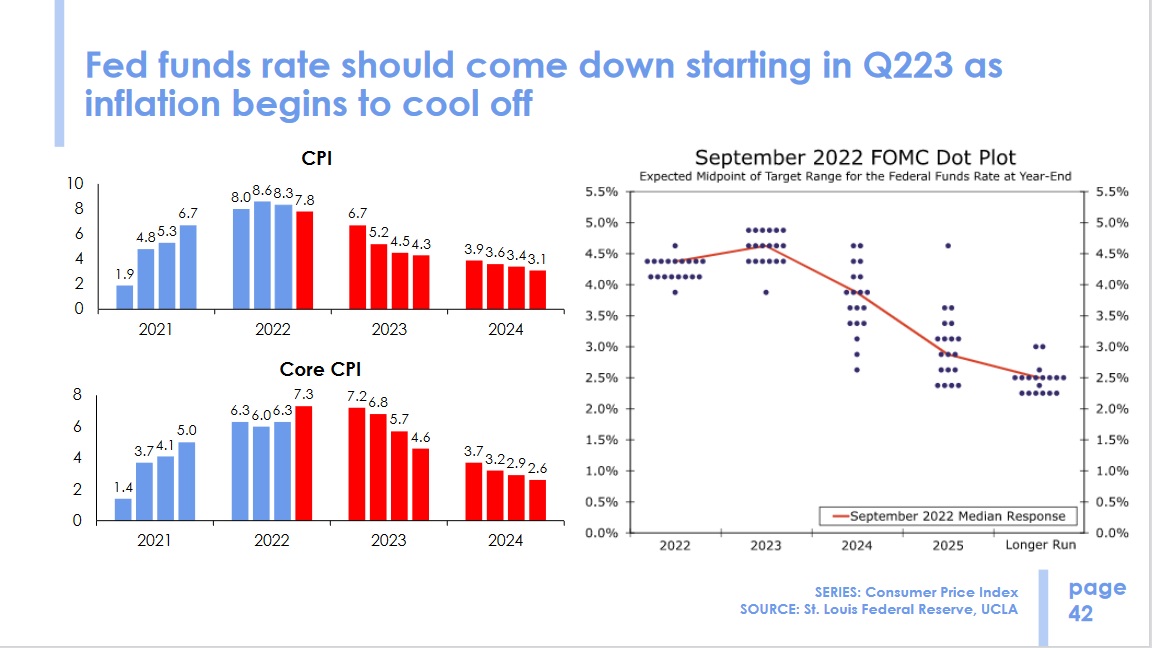
Fed Funds rate predicted to come down

Buyer demand in the housing market is dipping below pre-pandemic markets, as shown by the dip in mortgage applications in most of 2022, compared to 2018-2021.

Housing supply constraints continue, as shown by the number of housing permits issued, plus the number of years owners stay in a home before selling, another great cause of limited inventory. The current average length of stay is 10 years, whereas in 2006 it was 5 years before selling. 

Don't expect a surge in foreclosures, California has the lowest rate of foreclosure at .6%, and most other states are under a 3% rate for foreclosures. In recent years buyers have had higher down payments, creating greater equity in their homes, and the percentage of California buyers with second mortgages has decreased from 43% in 2006 to 2.2% in 2022.

California's median home price for 2023 is predicted to reduce to $758,600 from 2022's $831,000.

Housing demand will continue to pull back as economic uncertainty and affordability challenges remain
Supply shortage will still be an issue despite improvement in housing inventory in the short term
Prices will soften in the next few months but should begin to stabilize in H223
Inflation will remain a threat to the economy and the market in 2023
Rates will rise further and will peak in mid-2023
Buyers and sellers need REALTORS® even more to navigate through the market uncertainty

 Demand will continue to slow in 2023, and home prices will slow, but the type of market seen in 2009 is not predicted to occur, inflation is not predicted to abate until 2024, interest rates may continue to rise as the Fed tries to fight inflation. 


Thanks to CAR's Oscar Wei, Deputy Chief Economist, the source of this information at our Fall Forum.

Julia Huntsman, REALTOR, Broker | http://www.juliahuntsman.com | 562-896-2609 | California Lic. #01188996

10/19/2022

California Housing Market for September, and 2023 Annual Prediction

 According to California Association of Realtors report on current sales and pricing for September, the existing home price in September for Southern California was $783,380, a year to year increase of over 3%, but existing home sales slipped since last May and are down over 32% year to year.  Sales dipped as rates climbed - pending sales fell more than 40% as mortgage rates hit 20-year high.

So Calif Housing Prices/Sales

The California median price is up from last year, but dipped to a seven month low, $821,680 and the median price for a condo/townhome is $620,000.  The sales price to list ratio dipped to the lowest level since 2019, and the share of homes selling above asking price was 28.3% vs. 72% in the Spring of 2022.

In Los Angeles County in September, approximately 30% of homes sold over list price, the highest being San Francisco County at 64%.  

While inventory slipped a little, it's still comparable to pre-pandemic levels of being under 3 months (normal is 6 months, not seen since 2012).  Active listings have increased over last year but still lower than 2018 and 2019.  Southern California has seen the largest growth in active listings over all other California regions.   Time on market was a median of 22 days, double that of one year ago. Sales to list price ratio was 97.7%.  The median reduction amount for reduced price listings was 5.6% while 44.5% of listings had a reduced price.

2023 Calif Housing Forecast

The October annual CAR forecast at the Long Beach Convention Center predicts an overall softening of the housing market for 2023 by about 7%, where the median price is $758,000 vs. the current $821,680. This may be a relief for some buyers, however the 30-year Fixed Interest Rate is predicted at 6.6%, and in recent days has threatened to increase even more.  Buyers may be interested to know that mortgage lenders are bringing back programs that will help some buyers with grants, etc., to help their buying process.

Julia Huntsman, REALTOR, Broker | http://www.juliahuntsman.com | 562-896-2609 | California Lic. #01188996

10/05/2022

House Representatives Introduce Bill to Increase Capital Gains Exclusion

The "More Homes on the Market Act" was introduced on September 29th by Jimmy Panetta (D-CA) and Mike Kelly (R-PA), proposing increases in the capital gain exclusion amounts.  Under this bill, the exclusion amount of the sale of a principal resident for single filers would increase to $500,000 (now $250,000) and to $1 million (now $500,000) for joint filers.

homeowners may gain capital gains increase
Homes May Benefit from New Capital Gains Bill

This bill would provide tax relief for California homeowners, who are experiencing one of the highest cost markets in the nation, who have been unable or not wanting to move because of the large tax burden that  could result if they sold in the current market.  Senior citizens are more likely to face a larger tax burden since they have on average lived in their homes longer than younger age groups. 

The current capital gains exclusion was passed 25 years ago, with no indexing for inflation, in a different market which was not experiencing such huge equity gains. According to Rep. Panetta, "The current exclusion amount was first set in 1997 and was not indexed to inflation. If it had been indexed for inflation, it would be $461,325 for single filers and $922,650 today," amounts similar to the current proposed exclusion.  The new proposed bill does include indexing for inflation.

The current capital gains rate is  concurrent with fewer homes are on the market, which has contributed to higher demand and higher prices.  The National Association of Realtors estimates that single (95%) and married homeowners (68%) who purchased before 2000 could face capital gains tax if they sold their homes this year.


Julia Huntsman, REALTOR, Broker | http://www.juliahuntsman.com | 562-896-2609 | California Lic. #01188996

9/24/2022

Just Listed, South Wrigley Charmer in Long Beach


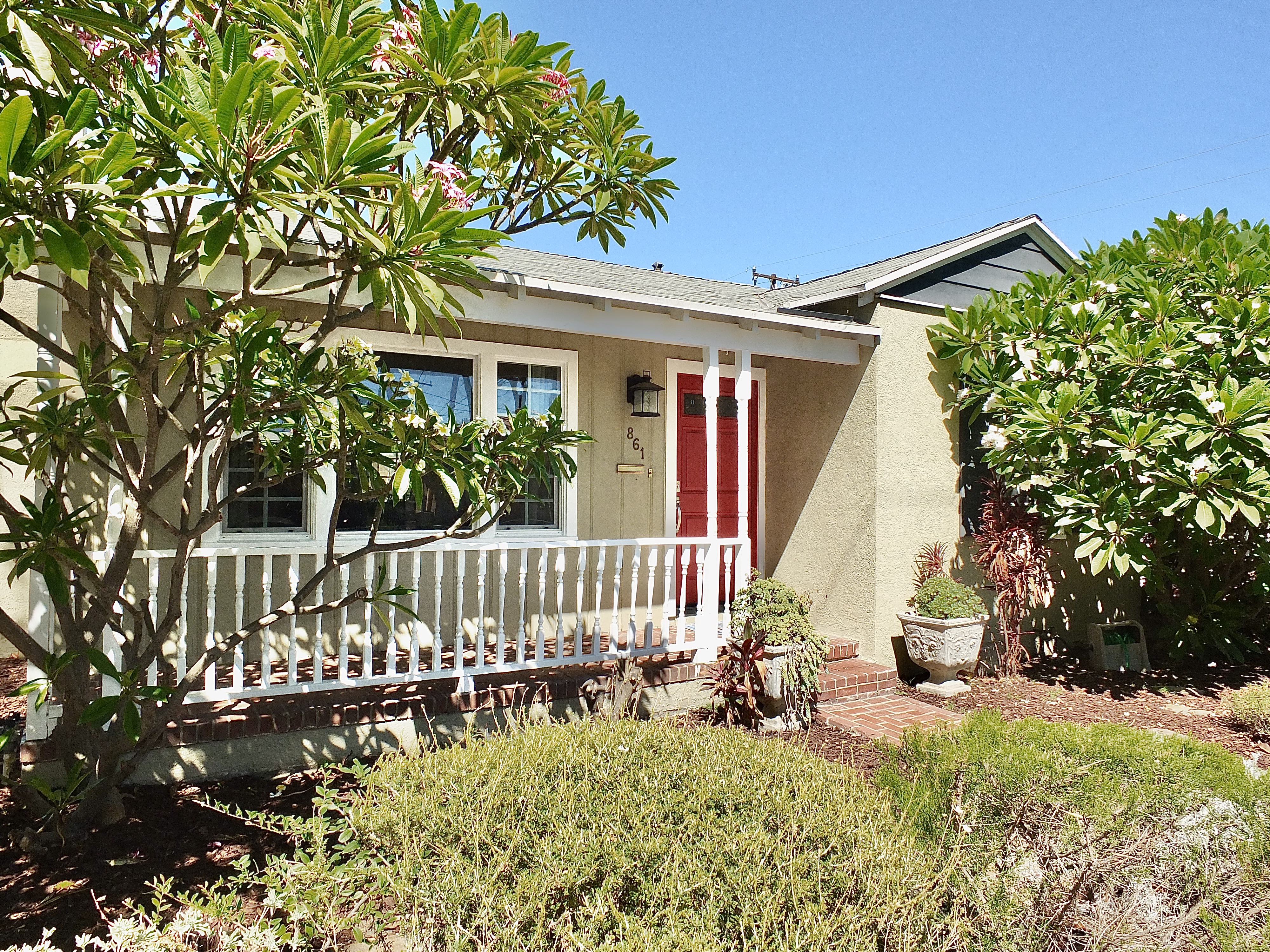
Front porch of Wrigley home
Sofa, hardwood  floors and fireplace
Living Room and fireplace


Update:  this property is listed as of 11/22/2022 for $720,000.  Best of this Wrigley neighborhood in Long Beach, this lovely home at 861 W 21st St is ideally located for those who need to commute to nearby Lakewood/Long Beach/

Backyard gazebo

Formal dining room and china cabinet

Los Angeles areas for work, or just want a very comfortable two-bedroom home.  Spacious back yard patio and gazebo with yard is ideal for entertainers or gardeners. Front xeroscaping is suitable for the environment, new driveway gate offers privacy and security. Art Deco styling is typical of the 1935 era, and newer plumbing is a maintenance asset. See it all at the MLS listing. Contact listing agent for more information, or visit my website below to see "featured properties" or open houses tab. List price at $740,000.  Find out more information for a $5000 grant for the buyer and qualifying for a special program.  Such programs may be helpful in buying down an interest rate, and saving money on the monthly mortgage!

Wrigley home with red front door, front porch, landscaping
 

Julia Huntsman, REALTOR, Broker | http://www.juliahuntsman.com | 562-896-2609 | California Lic. #01188996


9/16/2022

August 2022 State and Los Angeles County Market Reports


Calif August sales and price report

Statewide, California inventory reached highest level since 2019, but at 2.9 months of supply is still well under the norm of 6 months.  Both time on market and median price of a single family home were up, making some sellers who only knew the previous pandemic market ask why it was taking "so long" to sell?  Well, there's nothing wrong with being on the market 19 days before selling. It actually is good to give both buyers and sellers time to think about choice of property and for sellers to review an offer.

Los Angeles County Market Update


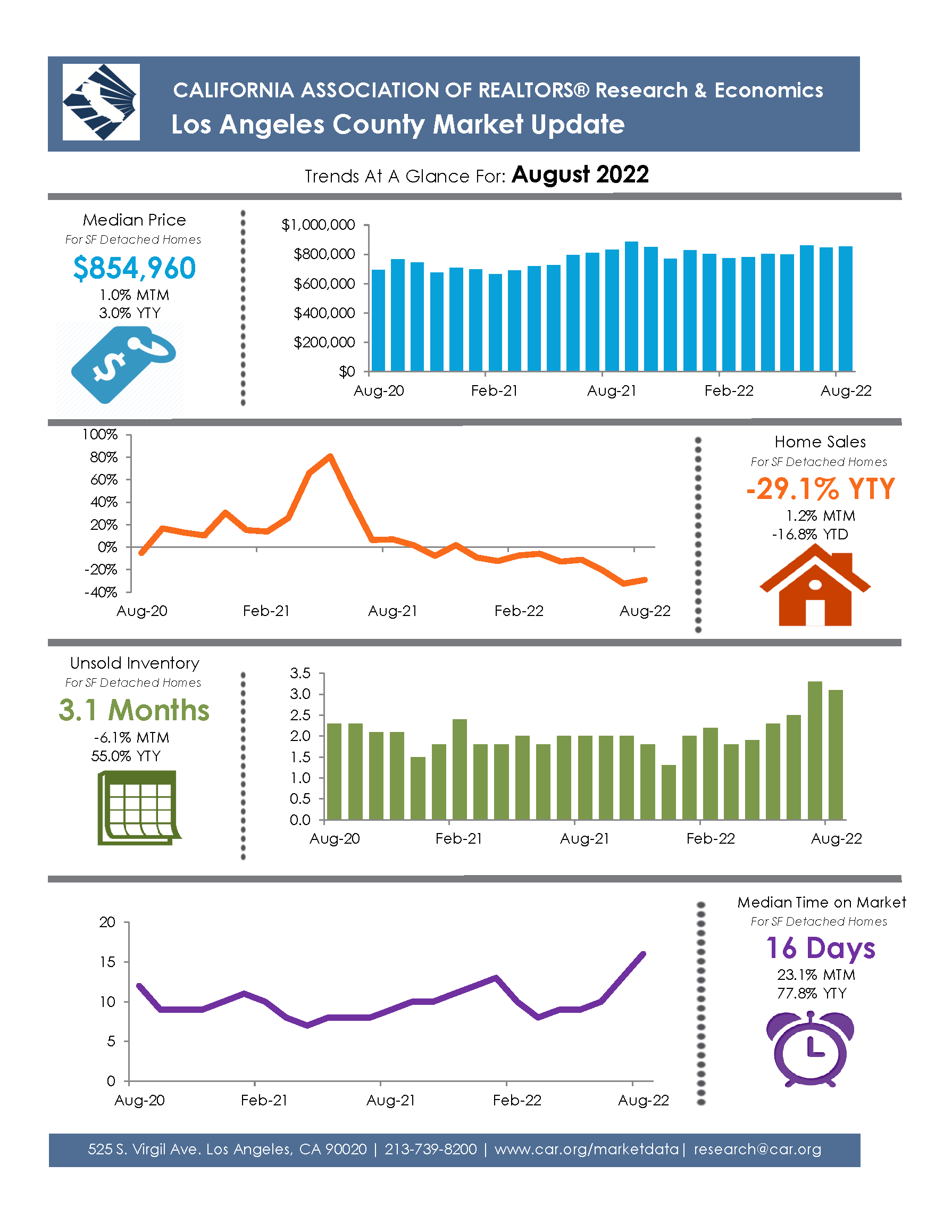
For the County of Los Angeles, inventory in August was at 3.1 months, with the median price of a single family home at $854,960, a 1% increase from the prior month, and a 3% increase from one year prior.  But total home sales in the County decreased over 29% from this time last year, although they increased about 1% from the previous month.   Median time on market for the County was 16 days, a 77% increase from this time last year.

Interest rate volatility, and upward jumps, have had an impact for many buyers, and with conventional rates around or above the 6% level now, although still low by historical standards, will continue to impact buyers dependent on mortgage financing.  From California Association of Realtors:

“It’s encouraging to see that August’s sales pace rebounded above an annualized 300,000 units sold,” said C.A.R. Vice President and Chief Economist Jordan Levine. “Although we do not expect a rapid bounce-back because the Fed is expected to continue raising interest rates to get inflation under control, the monthly increase in closed and pending sales suggests that the market may have already priced in most of the rate increases to date. Still, buyers will continue to grapple with rising costs of borrowing, which will keep home sales below the 350,000 annualized pace for the remainder of the year.”


Julia Huntsman, REALTOR, Broker | http://www.juliahuntsman.com | 562-896-2609 | California Lic. #01188996

8/17/2022

How Much Froth in the Housing Market is There?

Mortgage interest rates have been volatile, going up and down on a daily basis--today's rate (August 17) is at 5.22% per https://thefinancials.com for a 30-year mortgage, but recently it was up past 6%.  This has been affecting buyer behavior a lot for the purchase market, and has been slowing the sales volume for sellers.  However, while market time is longer than it was in the crazy pandemic purchase market, it is still not a buyer's market, just a somewhat longer selling time for sellers. 

Credit: Steven Thomas--Housing Reports
Price reductions in Los Angeles County equals 35% of market listings as of last week; Orange County reductions at 39% of market listings last week, and so on for Southern California counties. 

What counts right now for sellers is really taking stock of how you as a seller compare to your nearby home sales in terms of curb appeal, views, upgrades, remodels, and showing condition, on a more specific level than has been happening since before the pandemic price surge.  There are more listings on the market, but still not at the "normal" 6 month inventory level, and in fact, the Long Beach inventory level for July single family homes and condominiums was still only 1.9 months! On a national basis, it's more like 3 months--so in spite of the media attention given to some kind of housing debacle, there is in fact still a demand for inventory.  Increased interest rates have definitely affected buyers--the super low rates are not around, and the higher rates have pushed up monthly mortgage costs that many people cannot absorb.

 For a more complete weekly analysis of the Southern California real estate market, visit Orange County economist Steven Thomas at his weekly show.

Local market update for average single family home prices in July by zip code: 

Long Beach

90803 - $1,665,375

90815 - $1,008,650

90808 - $1,093,065

90806 - $728,800

Lakewood 

90712 - $817,938 

90713 - $855,535 

Signal Hill

$1,170,000 

Cerritos

$1,022,733

If you are thinking of selling, or would just like to know the market pricing for your home in the next 30-60 days, please contact me, I will be happy to assist you in person or online.  


Julia Huntsman, REALTOR, Broker | http://www.juliahuntsman.com | 562-896-2609 | California Lic. #01188996
8/08/2022

Do You Own a California Vacant Home? It Might Be a Housing Crisis Issue.

Should empty homes be taxed?

The City of Los Angeles, and many other cities, have been looking into this issue for years. The Alliance of Californians for Community Empowerment (ACCE) issued a report stating the City has more than 46,000 units in "non-market vacancy".  In 2020 another report said there were between 80,000 to 100,000 empty units throughout the city.  Housing advocates are often interested in the issue in order to house the homeless or "unhoused", but regardless of the target market, having so many units off the open market and unavailable to potentially qualified lessees/residents is a housing problem. And now many cities are thinking of taxing those properties. And, the California Association of Realtors estimated that around 1.2 million units, apartments and single-family homes may sit vacant around California. 

This is a kind of proposition that is usually easier said than done, but San Francisco, Santa Cruz, Berkeley have all worked towards a ballot proposition, while West Hollywood may discuss it next year. 

Also, Kate Harrison, Berkeley Vice Mayor, "cited a report in San Francisco finding vacancies are disproportionately in multi-family apartment complexes and in areas with older housing stock and higher rates of new construction. She said this suggests property owners are holding older units vacant to capitalize on new construction, and she wants a tax to send a message to these owners and “out of towners” who let property sit empty in a city they may not live in."

And, "The extraordinary gap between the housing needs of residents and the availability of housing can only be bridged through the use of numerous policy interventions, including a vacancy tax intended to incentivize owners of housing property to bring units back on the market and discourage speculation," Berkeley city staff wrote.

Vacant properties attract nuisance as well. It's better for cities and neighborhoods to have occupied homes, but is forcing property owners via a tax going to achieve the desired result?  In San Francisco, it could bring 4500 units back on the market with their proposed tax scheduled to launch in 2024. If it's successful, it would continue to pave the way for other cities.
 

Julia Huntsman, REALTOR, Broker | http://www.juliahuntsman.com | 562-896-2609 | California Lic. #01188996

8/05/2022

Where is Market Pricing for last 90 days in Long Beach, Cypress, Lakewood?

View toward downtown Long Beach

The following cities sold statistics for single family homes for the last 90 days:

Cypress, average sale price of 56 homes: $1,055,946, 15 days on market.

Long Beach, average sale price of 446 homes:  $1,052,166, 15 days on market

Lakewood, average sale price of 176 homes: $830,722, 14 days on market


Julia Huntsman, REALTOR, Broker | http://www.juliahuntsman.com | 562-896-2609 | California Lic. #01188996

Housing Update in Los Angeles County and Southern California

Interest rates and inflation are issues right now, not just here but globally.  Older populations in some other countries are problematic, without replacement population the consumer consumption is less. 

In the U.S., the Fed is trying to slow down inflation with rate hikes on many instruments, such as credit cards, but the Fed doesn't control the mortgage interest rates, per se.  Mortgage interest rates were over 6% in June, but are now down to just over 5%, with it being an extremely volatile market.  6.5% is a slight buyer's market, 4.5% is a slight seller's market. 

Do two negative quarters of the GDP indicate a recession?  The National Bureau of Economic Research calls the recession, and doesn't use the model of two negative quarters, but uses several other combined market indicators which it says are not yet flashing red. The jobs statistics came out very strong, and with current consumer consumption, which accounts for 70% of the U.S. economy, keep from calling a complete recession.  And recession doesn't equal a housing crisis, with interest rates going lower there is an increasing demand for housing.

Inventory in Southern California has climbed from 10,000 listings in January to over 30,000 listings in August.  The peak is projected to be in September, which means we are not yet back to pre-COVID market norms. In Los Angeles County, 31% of inventory has reduced its price, due to the current market shift and slow down.   Last year time on market was 33 days, today it's 77 days in Los Angeles County, which is still considered a seller's market, 90-120 days on market is considered a balanced market, and above that is more of a buyer's market.

Sellers:  Rather than reduce your price, offer the buyers a rate buy down.


Thanks to Steven Thomas for his excellent Housing Market Report.

Julia Huntsman, REALTOR, Broker | http://www.juliahuntsman.com | 562-896-2609 | California Lic. #01188996

6/27/2022

National Existing Home Sales Snapshot by National and California Association of Realtors May 2022


According to market research by National Association of Realtors, on a national level May 2022 brought 5.41 million in sales, a median sales price of $407,600, and 2.6 months of inventory. The median sales price is up 14.8% year-over-year, and inventory was up 0.1 months from May 2021.

Existing Home Sales May 2022


 California Association Realtors snapshot of the Long Beach housing market graphic shows a 14% decrease in existing home sales at a $940,000 median price for single family homes, with only a median 8 days on market overall.


Long Beach May 2022 Report

Per Altos Research:  More inventory now than any time last year. Still 50-70% fewer than normal.


Julia Huntsman, REALTOR, Broker | http://www.juliahuntsman.com | 562-896-2609 | California Lic. #01188996
6/03/2022

Profile of Home Sellers in 2021 - How Did They Sell a Home?

The 2021 Profile of Homebuyers and Sellers is the 40th anniversary of the first National Association of Realtors report. The 2021 report is unusual because it is the first full year in which buyers and sellers purchased or sold during the COVID-19 pandemic, in what turned out to be a record setting year.

Long Beach Spanish bungalow

As discussed in the buyer post, this was based on a survey of homesellers' experience.

The median stay in a home in 1985 was just five years, in 2021 the tenure in a home decreased to eight years (from previous year high of ten years).  (This is based on national data, some areas such as Southern California have been more than 8 and 10 years).  Tightened inventory saw sellers getting 100% of their asking price (and more) in one week or less.  Nationally, the median home equity at time of sale was $85,000 in 2021, compared to $66,000 in 2020, a significant increase.

  • The typical homeseller age was 56.
  • Of all homes sold, 69 percent did not have children under 18 residing in the home. 
  • Eight-nine percent of sellers identified as White or Caucasian, 
  • The share of first time homesellers was 32 percent, and only 6 percent of all sellers did not plan to sell the previous home.
  • Thirty-eight percent of the homes sold in 2021 were located in the South region, 24 percent were in the Midwest region, 22 percent were in the West region, and 15 percent were
    in the Northeast.
  • The majority of homes sold were single family homes (78 percent).
  • Forty-six percent of sellers traded up to a larger size home, and a majority of sellers purchased a home in the same state.
  • The over 65 age range downsized to a home 100 square feet smaller.
  • Buyers (former sellers) in the 35-44 age group bought the most expensive trade-ups by an increase of $101,000.
  • Sellers said they wanted to move closer to family, especially those who moved the greatest distance.
  • Time on Market - Sales vs. List Price
    Ninety percent of all sellers worked with a real estate agent, while FSBO sales were below the historic norm at 7 percent.
  • Less than 1 percent of sellers used an iBuyer program to sell their home.
  • Ninety-six percent of sellers working with an agent did not know the buyer.
  • Across all regions, the final sales price was a median 100 percent of the final listing price, the highest recorded median since 2002.
  • Sellers in home 21+ years had 162 percent equity.
  • Client referrals and repeat business were the ways seller found their real estate agent.

For a more extensive review of selling and marketing your home, please contact me -- I'm a broker with more than 25 years in the real estate business of helping buyers and sellers.

Julia Huntsman, REALTOR, Broker | http://www.juliahuntsman.com | 562-896-2609 | California Lic. #01188996

6/02/2022

Profile of Homebuyers in 2021: How Did They Buy a Home?

Buyers in 1981 vs. 2021
The 2021 Profile of Homebuyers and Sellers is the 40th anniversary of the first National Association of Realtors report. The 2021 report is unusual because it is the first full year in which buyers and sellers purchased or sold during the COVID-19 pandemic, in what turned out to be a record setting year.

Based on data collected nationwide between July 2020 and June 2021, the survey consisted of 129 questions via paper or online in both English and Spanish.  Consumer names were obtained from Experian which maintains an extensive database of recent homebuyers derived from county records (which are public). The entire report is 164 pages with multiple graphics covering aspects of buyers and sellers experiences, and information about working with their agents. 

This post will be about the buyer experience section, and will primarily be hitting the highlights. 

First time homebuyers grew to 34 percent, greatly helped by the low interest rates but then challenged by a housing market with lowered inventory, rising prices and much competition from other buyers. Buyers reported the most difficult task was finding the right home to purchase, and the time spent in a home search was only eight weeks.  Eight-eight percent (88%) of buyers used a real estate agent to help them purchase.  

The typical first time buyer was 33 years old, repeat buyers were up to an all time high of 56 years.  Sixty percent were married couples, 19 percent were single females, nine percent single males, and nine percent unmarried couples. The largest share of buyers were in the 25 to 34 age group, and the median income was $102,000,

First Step in Homebuying for all Buyers


The majority of buyers either began their search online or contacted a real estate agent as a first step in the home search. Few people read books about the homebuying process or attended a home buying seminar--even visiting open houses was lower in activity as an initial step in  the home search.


Information sources used in home search

For information, all age groups primarily turned to an agent and then to an internet device , and then visited open houses.

But where the buyer found the home they actually purchased was on the internet for 51% of buyers, through their agent for 28% of buyers, with much smaller percentages for yard signs, personal contacts, homebuilders or the sellers themselves.  This is a complete contract to 2001 when 8% of buyers found their home on the internet and 48% through their agent.

This is only a partial representation of buyer characteristics in the Report for 2021, for a complete copy of this study, please contact me via phone or email. 

And for help in buying a home, I can work with you with my 25+ years of experience.

Julia Huntsman, REALTOR, Broker | http://www.juliahuntsman.com | 562-896-2609 | California Lic. #01188996

5/31/2022

Why Shouldn't the Buyer Write a "Buyer Love Letter" to the Seller?


Fair housing issues are coming to the forefront of the real estate profession and being addressed at all national, state and local levels of the industry for REALTORS.  Problems with race, color, ancestry, gender, marital status, military affiliation, plus other groups of the legally protected classes continue to exist for many buyers and sellers in real estate transactions. Even appraisals have come under review.

One of the mechanisms by which discrimination may arise has been called the "buyer love letter" -- it arrives with the buyers' offer to a seller because it has been traditionally thought to help positively influence the seller into accepting an offer. They are often accompanied with photos, background stories about the buyer, and other personal history disclosed willingly by buyers who want to appear sympathetic to the seller, people who would love their new home just as much as the seller has, all designed to create a connection in order to get chosen for the contract.

This tactic has been addressed in the past, yet agents and their clients continue to submit such letters.  In one state, it is now outlawed.  In California they are not illegal, but agents are cautioned to advise their clients of the negative potential of this practice.  If a buyer insists on submitting such a letter, they are advised to eliminate personal information (but that's what some people hope will gain traction with the seller).  

Buyer Interest Letters, as they are official referred to, are considered a legal risk for unconscious or implicit bias. The buyer cannot really know what is in the seller's mind or background, and sometimes the seller doesn't either until the selection time comes, or the seller may not consciously be aware of their reasons for certain choices. Photos meant to present the buyer in a positive light may instead do the opposite, or personal buyer stories such as "I grew up in the neighborhood", "I have kids", or "my church is nearby" may elicit a negative reaction from the seller, or a favorable reaction towards a buyer but which excludes other buyers who do not have kids, a church or grew up in another state and thus cannot make any of those claims, and which in fact may violate one of the federal or state protected classes mentioned above.  So this is where Fair Housing issues come into the transaction.

The only information that I advise my clients to submit with an offer is the financial qualification dealing with price and terms of the offer, which in fact is required in the contract terms anyway, because the ability and motivation to buy are the actual buyer requirements. I do not advise my buyers to write any other personal information, and in fact, the seller may have actually instructed his/her agent to not accept any offers accompanied by a Buyer Interest Letter.

So please be aware that while a listing agent must notify the seller of all offers received, per California Association of Realtors: 

 "Even if the agent is following the seller’s instruction, the agent should disclose to the seller that an offer was received with a buyer letter and returned to buyer or agent per the seller’s instruction. Paragraph 10C(2)(A) of the C.A.R. Residential Listing Agreement, C.A.R. Form RLA, contains a seller instruction not to present buyer letters.  Only if the alternate paragraph 10C(2)(B) is checked is broker authorized to present such letters."

By carefully considering potential Fair Housing guidance, the parties will not be subject to doubts about their participation in the contract process.

Julia Huntsman, REALTOR, Broker | http://www.juliahuntsman.com | 562-896-2609 | California Lic. #01188996

4/30/2022

If You Are Over 55, Don't Forget About the California Proposition 19 Tax Transfer Benefits

Long Beach bungalow house

Are you a possible candidate for a Proposition 19 tax transfer?  California's Proposition 19 was passed in November of 2020 and made changes to property tax benefits for families, seniors, severely disabled persons, and victims of natural disaster throughout the state starting in 2021.  For a general summary of this tool, and examples of how homeowners can save, please go to Your Local Realtor Can Help You Save When Moving With a Prop 19 Tax Break. These current changes allow a homeowner who is over 55 years of age, severely and permanently disabled or whose home has been substantially damaged by wildfire or natural disaster to transfer the taxable value of their primary residence to:  

  • A replacement primary residence
  • Anywhere in the state
  • Regardless of the value of the replacement primary residence (with adjustments if "greater" in value)
  • Within two years of the sale
  • Up to three times (but without limitation for those whose houses were destroyed by fire) 

As with many pieces of legislation, this bill in its original form needed clarification in order for County Assessors to properly implement it, a process that is still continuing.  While prior Propositions 60 and 90 (intracounty and intercounty legislation) had certain limitations which the new Proposition 19 has expanded upon, Prop. 19 has also had some restrictions in place that didn't exist before, and it's important for owners to understand how it will work for them.

In general though, this bill is very useful, especially considering the overall cost of living in California in residential real estate prices, in allowing property tax base transfer reductions for homeowners over age 55, and other applicable owner categories, which will save money on the property tax of the new home purchase.  And, it may be applied up to three times for standard 55+ owners, but has no such transfer limitation where homes were destroyed by fire.

If you are considering moving now or in the future, please obtain more information from your Realtor professional and/or tax person about this tax transfer process.  Be aware also that at this time many County Assessors offices are dealing with many applications and homeowners are having to be patient.  If you are in Los Angeles County, go to assessor.lacounty.gov/prop19 for more direct information, and a forms tab to submit for your application. 

I am available by phone, text or email -- if you would like additional more specific information in a Q&A format, please contact me about this or any other aspect of selling a home.

Julia Huntsman, REALTOR, Broker | http://www.juliahuntsman.com | 562-896-2609 | California Lic. #01188996

4/18/2022

Are New California Homeowners Prepared for Home Maintenance Costs?

According to a recent survey discussed in the Scotsman Guide, 70% of a poll of 1600 recent homebuyers  had one major regret in their buying experience: reasons tied to "cost-based remorse".  Buyer, or seller, remorse is not unusual, nor has it ever been no matter in what market a transaction occurs--much of it, I believe, is due to unexpected aspects of the experience.  It's impossible to predict all events, but the more preparation, planning, and advance knowledge a party has, the faster the remorse will subside. 

Spanish bungalow
1920s Spanish bungalow

In today's market of fast moving market of competitive bids, advance preparation about costs and the subsequent homeowning experience is essential--because often in a fast-paced bidding war, time to think things out slowly doesn't exist.

Costs of owning your new home should be considered before you begin your househunt:

1. Age of home

2.  Location (nearer the ocean means salt air can affect paint and old foundation concrete)

3. Pest control (inspections every 2 years, please--termite and dry rot issues)

4.  Plumbing (replace sink and toilet valves before they break down or become impossible to turn; water heater may need replacement after a few years; waste lines; sewer lines)

5. HVAC system (vents need cleaning, furnace filters need replacing)

6. Gutter cleaning (clogged gutters cause water issues)

7. Fences (wooden ones degrade)

8. Landscaping maintenance 

9. Roof (Composition roofs with one layer may last 20-25 years--less if more layers)

10.  Home insurance (may go up due to rise in claims, climate issues, location)

How to budget for these costs on a general basis?  

Try the 1% rule: If the selling price was $700,000, reserve $7000 annually; or using the square footage rule, a 1200 square foot house will mean saving $1200 per year.  This may also depend on whether you own a single family home or a condominium (but monthly dues are also a homeowner cost). These are only initial estimates, but will also help a homeowner prepare.  More guidelines are at this site by State Farm (I'm not endorsing this company, only providing a link as a guideline). The buyer should search several sources, including their own insurance company, to gain estimates.  And see this real-life home-buying example of a couple in Gardena California and their cost/budget experience

Julia Huntsman, REALTOR, Broker | http://www.juliahuntsman.com | 562-896-2609 | California Lic. #01188996

3/30/2022

Long Beach Residential Unit Market

Did you know ...?

There continues to be a demand for Long Beach residential rental housing, and rents are at a premium.

The average sold price for a 4 unit property in 2021 was $1,321,209, which is up from an average price of $1,165,367 in 2020.*

Spanish style Belmont Shore units
Belmont Shore units

The average sold price for a 2-3 unit property in 2021 was $987,857, up from an average price of $883,062 in 2020.*

Currently, the average list price in Long Beach for 2-3 unit properties is $1,094,045, and for 4 unit properties the average list price is  $1,336,468.  Actual rents for  a 2 bedroom/1
bath may average about $2150/month, with proforma rents being a little higher depending on the size and area location, i.e., downtown, North Long Beach, Belmont Shore.* 

The last 90 days of average sale price of a 2-3 unit property, citywide, is $1,153,356 -- 24 of 59 properties sold over list price.  The average sale price for a 4-unit property is $1,375,283 -- 4 of 18 properties in the same time period sold over list price. 


Unit sold prices in Long Beach

To see active listings for duplexes, triplexes and 4-unit properties in Long Beach, please go to this search  which may be revised to include other types of properties, and other cities.

For an online (or in person) valuation of your income property, just contact me.

 *Information from CRMLS.                    

Julia Huntsman, REALTOR, Broker | http://www.juliahuntsman.com | 562-896-2609 | California Lic. #01188996

3/29/2022

Long Beach Condominium Market--More Affordable for Many Buyers


Currently there are 62 active condo listings in across Long Beach, with the overall average price being $562,469 per MLS data.  This is a lower number than the 90 current house listings, however, SFR average price for the entire city of Long Beach is $1,226,196, significantly higher than the condo average.  While condo prices range from $1,500,000 down to $270,000, the median and average prices are well below $600,000.  

555 Maine Ave

There are currently 131 condos in escrow with an average of 29 days on market, while there are 100 single family homes in escrow with similar days on market, and of course at a much higher average price than the condominiums.  

Condominiums are located throughout almost all areas of Long Beach and provide an avenue to homeownership in a neighborhood which may otherwise be totally unaffordable to the buyer. Older HOAs may not offer enough parking for all owners because the building requirements before the 1980s were different, but later developments were required to offer a parking space per the number of bedrooms in a unit.  And, older developments were most commonly built with community laundry rooms, while later ones offer inside laundries and central air and heat.  Many older buildings, however, feature more interior square footage and seem more spacious. Condominiums may have more rules to meet for lender approval on a buyer loan, because the lender looks not only at the unit, but also at the common area maintenance and condition, so buyers searching for a condo home should keep this in mind.  Rules and regulations of HOAs are part of the buyer's new homeownership--living in a condo is a certain way of living that is different than a single family home, but in today's market, especially, it offers ownership opportunity.

Long Beach also has some lower priced stock cooperatives and own-your-own properties which appear to be condos but are not, which are also affordable buyer opportunities, but do have some different mortgage requirements. If you find such a property on the market and want to find out more, please contact me.  To find condos on the market in Long Beach, go to my condo search .

If you're a seller thinking of making a change and you want to put your condo on the market, please contact me for important information about selling your condo. I have 25 plus years of experience and have sold numerous condominium units.


Julia Huntsman, REALTOR, Broker | www.juliahuntsman.com | 562-896-2609 | California Lic. #01188996
3/24/2022

Who Wants to Buy a House? Millennials Do Too.

If you watched 60 Minutes on March 20th, you probably saw the segment with Lesley Stahl about the rental market, specifically the corporate rental market.  While Gary Berman of Tricon, whom she interviewed, stated that the corporate landlord represented only about 2% of the total national rental market, it is a powerful segment.  Because their homes are turnkey in a rising market, their rents may be up 30% or more compared to a previous year: examples were 35% higher rents in New York, 39% higher in Portland, 10% higher in Los Angeles, but surprisingly down in Kansas City.  There has always been part of the population which by choice prefers to rent--such renters actively do not want the responsibility of maintaining property.  And then there is the segment of the population which may have good income, but is cash poor, or has credit ratings below the mortgage approval guidelines.  But increasingly are those young renters who would like to buy their first home, have excellent qualifications to get a mortgage but may not have enough cash to compete in over-list-price multiple bid offers or enough to obtain a 20% down loan, perhaps 5% down is the best they can do.  

 View from porch of home

But one thing that I don't believe is true are the younger buyers--typically in the under-40 millennial age group--who have been characterized in multiple media sources in the last few years as being uninterested in owning a home.  This was made clear by the young couple spotlighted in the 60 Minutes show, who directly contradicted the statement made by Mr. Berman that millennials "don't desire to own a home" because their main emphasis is living in a turnkey space and thus fit the profile of "You can rent the American dream" as opposed to owning it, which young couple made it clear they wanted to be able to buy a home, but competing in the current buyer/seller market was extremely tough for them.

In my experience, adults of all ages would prefer to live in a turnkey home, not just younger adults: and if not turnkey then a home purchase that presents a clean, relatively updated condition.   The view that younger adults don't care about owning a home is a misrepresentation that can ultimately deny them the opportunity to own, thereby gaining housing and community equity.

The current trend in asking buyers to remove standard contract contingencies can be a direct pathway to housing disaster for  a number of reasons--yet this is what many younger (and older) adults encounter in the home offer process, and is indeed discouraging, and just influences their continuing status of being a renter when they would like to be an owner.  The upward price climb is staying in motion, but other things do not have to, and should not.  Sellers should be advised of the risks involved.

See the 60 Minutes video .  

Julia Huntsman, REALTOR, Broker | www.juliahuntsman.com | 562-896-2609 | California Lic. #01188996

Web Statistics