5/22/2012

Long Beach Parks Summer Concerts for 2012


Now that "House" is over and gone forever, there's no reason to not remember the summer concert schedule for the Long Beach Municipal Band.
Long Beach is lucky to have such a music resource, not every city can maintain its own group of musicians.  Plus, Larry Curtis, the band conductor, used to be the conductor for my high school band eons ago, so that's another reason I like this band.
Week 2:
Week 1: July 10 TBD
July 5 Marine Stadium
July 6 El Dorado Park West
July 11 Los Cerritos
July 12 Marine Stadium
July 13 El Dorado Park West
Week 3: Week 4:
July 17 TBD July 24 TBD
July 18 Los Cerritos Parks July 25 Los Cerritos Parks
July 19 Marine Stadium July 26 Marine Stadium
July 20 El Dorado Park West July 27 El Dorado Park West
Week 5:
July 31 TBD
August 1 Los Cerritos Parks
August 2 Marine Stadium
August 3 El Dorado Park West

http://www.longbeach.gov/park/recreation/lb_municipal_band.asp


5/21/2012

Don't Overlook California CO Detectors

Carbon monoxide is colorless, odorless and toxic. It's called the "silent killer" in homes because some victims are not even aware that the deadly condition exists.
In California, detectors must be installed:
(1) For all existing single-family dwelling units on or before July 1, 2011.
(2) For all other existing dwelling units on or before Jan. 1, 2013.
Where should they be placed?  For minimum security, a CO detector should be centrally located outside of each separate sleeping area in the immediate vicinity of the bedrooms, and  should be located at least 6 inches from all exterior walls and at least 3 feet from supply or return vents. I have even heard that during escrow, some appraisers will "call out" a missing detector on their appraisal. If you're a homeowner or landlord, don't wait to comply with this requirement now.
Property owners must be concerned about unmaintained furnaces, water heaters and appliances that can produce the deadly gas. Other sources could include leaking chimneys, unvented kerosene or gas space heaters and even exhaust from cars operating in an attached garage.
The Environmental Protection Agency suggests the following to reduce exposure in the home:
  • Keep gas appliances properly adjusted
  • Install and use an exhaust fan vented to the outdoors over gas stoves
  • Open flues when fireplaces are in use
  • Do not idle your car inside a garage
  • Have a trained professional inspect, clean and tune-up central heating systems annually
Lower levels of carbon monoxide poisoning can be mistaken for the flu.
It's also possible to buy them in combination with a smoke alarm. Read more at HouseLogic.

5/10/2012

Investor Buyers are Making a Difference in This Market

Investor buyers, do you know you make up about 27-30% of the current buying market?  Most investor buyers are looking to hold onto their properties for a while--only 5% of properties purchased last year have been re-sold.

The second home market surged in 2011, according to data from the 2012 NAR Investment and Vacation Home Buyers Survey. The combined market share of investment and vacation homes rose to the highest level since 2005.

Investment home sales in 2011 jumped 64.5 percent over 2010. Vacation home sales climbed seven percent, year-over-year, and accounted for 11 percent of all transactions last year.

5/09/2012

How Many Single Family Homes Under $300,000 in Long Beach?

Since this Spring of last year, the last time I wrote this post, not as many as last year.

The great majority of residential properties included here are single family houses and condominiums; the list also includes lofts (a separate MLS designation), own-your-owns and co-ops. The grand total from SoCalMLS is 340 listed as "active", regardless of selling condition (short sale, REO, probate, etc.), or the amount of HOA dues in the case of common area properties.

This inventory is quite different from one year ago when there were a total of 618  on the market.

The breakdown includes the following:

5/08/2012

Increase in April Home Sales Prices for Long Beach, and Nearby Cities

Based on MLS data, 10K Research&Marketing
Long Beach home sellers may finally take heart at some continuing good news. While the citywide accumulated median and average price for single family home sales continues to decline from last year, the April 2012 comparison to the same time last year actually shows an increase in median and average sales price:  Median - from $374,500 to $381,000;  Average - from $421,796 to $424,441.

The average price from April 2011-April 2012 for condos and townhomes also shows a 10% increase, from $211,280 to $232,676. 

As above, the "rolling" 12-month calculation for both categories still shows a decrease in prices, however.  With the increase shown in pending sales compared to last year, more buyers are buying. But the 50% cut in inventory levels say that many possible sellers have yet to decide to put their properties on the market.  In fact, Long Beach had the highest number of closed sales (226) in April over all the other 60+ cities in this report area.

4/27/2012

6 Don’ts After You Apply For A Mortgage

I learned a long time ago that “common sense is NOT common practice“. This is especially the case during the emotional time that surrounds buying a home, when people tend to do some non-commonsensical things. Here are a few that I’ve seen over the years that have delayed (and even killed) deals:
  1. Don’t deposit cash into your bank accounts. Lenders need to source your money and cash is not really traceable. Small, explainable deposits are fine, but getting $10,000 from your parents as a gift in cash is not. Discuss the proper way to track your assets with your loan officer.
  2. Don’t make any large purchases like a new car or a bunch of new furniture. New debt comes with it, including new monthly obligations. New obligations create new qualifications. People with new debt have higher ratios…higher ratios make for riskier loans…and sometimes qualified borrowers are no longer qualifying.

4/16/2012

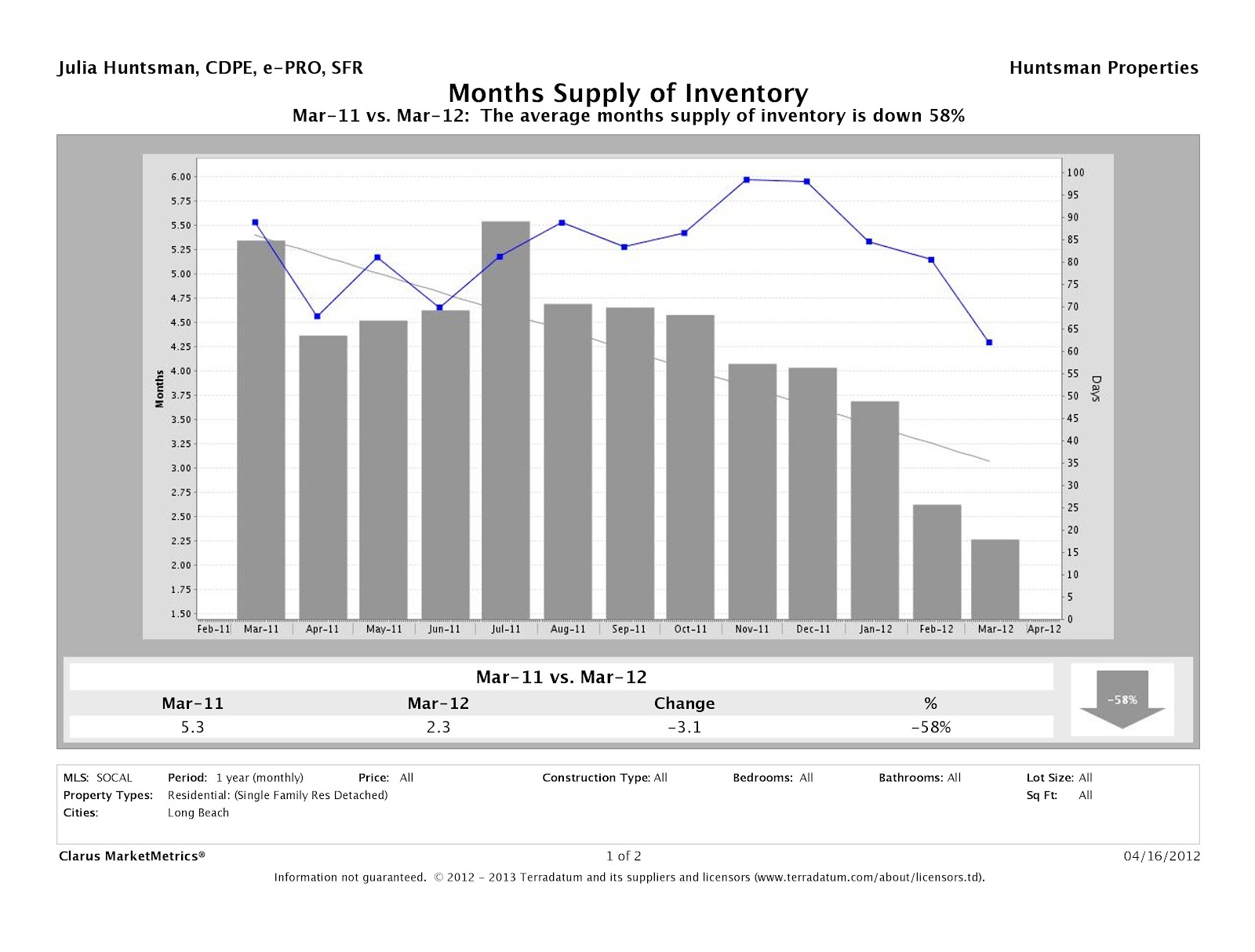
Long Beach Needs More Single Family Homes on the Market!

Long Beach Inventory
Long Beach--two months inventory
For the last year, since March 2011, the Long Beach median prices have been jumping around.  The median prices for listings and sales have gone up and down for the city, overall. These charts show the overall market, which varies in price quite a bit, and lumps all distressed properties in with regular sales.  In March of last year, the median price was $365,000, and for March of 2012, the price is $369,900--while the "sold" prices have actually gone down. But what is in escrow? That's where the prices in 1-3 months may be showing an upward trend, because sales activity has picked up a much faster pace:  the number of single family properties (both distressed and regular sales) in escrow is up 40%, and is at the highest number in the last 12 months.

Long Beach Median Price march 2012
Median price for listings is up again in Long Beach
And another thing is very clear: in checking with Long Beach, Lakewood and Cerritos, all cities are down to two months or less of inventory for single family houses. The second chart clearly shows a downward trend in numbers of listings on the market since last summer.

That means if no new listings came on the market, the current inventory would be sold in approximately 2 months at the current rate of sale.
Sellers should start contacting their real estate professional now to review their best position for selling, because the buyers, both investor and owner-occupant types, are buying!

I am available to help you as your real estate professional, just give me a call, e-mail me, or contact me through my website at www.juliahuntsman.com.

4/12/2012

California Foreclosure Study by San Francisco Assessor

This information just came in this afternoon to me from Duane Gomer, a real estate trainer active in the real estate market:
The San Francisco Assessor commissioned a foreclosure study during 2009 and 2011. The results are revealing and stunning to me and I’ve studied this market for decades. For example: 1 – 99% had irregularities, 2 – 84% had violation of law, 3 – 75% had issues with the assignments of the trust deeds, 4 – 84% had problems with the substitution of trustees, 5 – 59% had evidence of backdating, 6 – 45% the foreclosing party had never been assigned the loan. The Assessor’s conclusion: The California Non-Judicial Foreclosure System is “utterly broken” and needs repair.
Just as further comment, the California non-judicial foreclosure law and procedures is explicitly spelled out in California code. 

This study of 382 San Francisco homes between 2009 and 2011 was conducted by a Newport Beach-based company, and a February 2012 Orange County Register article goes into more detail here.

3/27/2012

Number of FHA Qualified HOAs Falling Drastically

This afternoon I was sent a list of FHA-approved condominium complexes for Long Beach.  They now currently number 34, with two approvals expiring in April, leaving 32 for all of Long Beach.  This is a huge reduction in number compared to a few years ago--these approvals are dropping off for two reasons: HOAs don't realize the requirements have changed or that their approval has expired and that they must renew again, or the HOA complex's financial circumstances don't currently meet FHA guidelines.  But I believe many complexes fall into the first category.

If you are an HOA member, or know someone who is, think about this: If your complex is not approved for FHA-HUD loans, you greatly reduce the number of approved buyers who can bring an offer, thus probably delaying the selling date of your property.

If you are a buyer with an FHA approved loan (especially one being used with certain buyer assistance programs), your selection is now greatly reduced because you simply will not be able to buy in a non-FHA approved condominium complex.

Property owners, you should take active steps to look into this issue.  With today's loan qualifying requirements, FHA loans are accessible for many 1st time and repeat buyers, and in the future they will become even more critical as former owners of distressed properties re-enter the market.

So you think you're going to keep living there, and it doesn't matter?  What if you would like to get a reverse mortgage?  They require your complex to be FHA approved.

Yes, there are lenders willing to qualify your association during escrow, but don't wait until then--it's a much longer process, and the buyer could decide to find another property.

Or the alternative is, if you're a buyer, be prepared to use a lender not of your choice, but one of the few who can give you a similar loan without needing to go FHA. In that case, call me, and I can send you to the right place.

But owners, remember, there are still FHA approvals required for reverse mortgages, therefore contacting your Board of Directors should be at the top of your agenda.

3/26/2012

Positive News in the Long Beach House Market

LB market up in some areas
While it's certainly not true everywhere, the coastal area news is surprisingly up!

Comparing February 2011 to February 2012 in 90803 zip code, there's a huge increase in sales prices! and a huge decrease in the listing supply, and a (huge) increase in pending and closed sales.  Average sales and median prices comparing the two February periods increased by 63% and 41%!

And when comparing the average 90803 sales price over the entire year period, the average sales price increased from $717,997 to $724.188.

This exact same price scenario is not true in all areas, however, but in general it is true throughout Southern California and elsewhere that sales activity has increased greatly, and listing inventory has decreased.

In the 90807 area (Bixby Knolls, California Heights, etc.), the median and average sales prices have increased for the February year comparison period by 16 and 17%, but is down 5-7% when looking at the entire last 12 month period, wtih a 20% increase in closed sales. Again, listing inventory is down by 37%.

Low interest rates are helping to fuel the march towards more buyers finally getting into the act of buying.

If you know of someone thinking of selling, is now the time to start making that move?

For a similar report for your area in Long Beach, Lakewood, Cerritos, Bellflower, San Pedro, Cypress, Seal Beach, Huntington Beach and many other cities in Los Angeles and Orange Counties, just contact me via e-mail or phone!

See more news: Local Regional Market Report--March 2012 -- and check out the 1-Minute Newsletter tab above.

3/22/2012

The 5 Best Home Improvements Projects in Southern California

It's should be no surprise that costs have gone up, but important to know is that the 9-year trend shows a downward cost-value ratio. But still, the Pacific Region in the 2011-2012 Cost vs. Value Report states, "In Pacific Region markets, the high cost of remodeling is more than offset by high values at resale, giving it the highest average cost-value ratio (71.3%) in the country."  And, overall, the report puts the top 10 projects nationwide as giving a value between 69-78%. 
Remodeling Magazine: Regional Comparison
Sellers, at this point, please take note that 1) because you put in a $40,000 bathroom remodel doesn't mean the value of your house went up $40,000, and 2) taking care of deferred maintenance projects, unless a large remodel/upgrade is the replacement, does not add a higher price tag to your home.

And, keep in mind that a low-cost re-do of $3000-$4000 can often be enough to prepare a property for sale, i.e., low-cost kitchen fix-up, vs. spending $19,000+.

Nationally, siding, window and door replacement projects were in the top 10, because certain costs have actually decreased, and also because they are under $19,000. Garage door replacement is now 6th in popularity (it was 13th in the past), and is 15% cheaper than a few years ago. Vinyl siding and vinyl window replacements are also in the top 10.  With remodel projects, adding an attic master bedroom/bath continues to rank in the top 10.  With single-story houses that were originally a two-bedroom/one bath, going up to add more living space has gotten high marks.

For the Pacific Region including California, the following are the top 5 value projects:
  1. Minor kitchen remodel stands out at retaining 91% of its value ( replace: cabinet fronts with new raised-panel wood doors and drawers, including new hardware;  wall oven and cooktop with new energy-efficient models; laminate countertops; install midpriced sink and faucet. Repaint trim, add wall covering, and remove and replace resilient flooring).
  2. Garage Door replacement -88%
  3. Entry Door replacement - 85%
  4. Deck addition - 81%
  5. Window replacement - 81%
Places to look  for contractor sources may be at local tile and kitchen shops, local area classified ads, online directories, and of course, referrals from friends.

3/16/2012

What to Know about the Mortgage Settlement with 5 Major Servicers

The Road to Solutions
The $25 billion proposed settlement with five major banks/servicers has not yet been approved by a judge. However, assuming it is as proposed, Bank of America, Wells Fargo, JPMorgan Chase, Citigroup and Ally Financial will agree to stop the practice of robo-signing, to change their loan modification procedures, and to not foreclose on borrowers who are being considered for a loan modification. A single point of contact and adequate staff to handle consumers are also to be established by each bank. Approximately $20 billion is to go to those facing foreclosure--principal loan reduction and refinance--and $5 billion goes towards settling with consumers who lost their homes due to improper foreclosures between 2008 and 2011. Part of the settlement agreement will result in new requirements for short sales, which is supposed to speed them up and eliminate the often lengthy delays. A fact sheet describes cash payments to borrowers who went through foreclosure.

This settlement is not yet finally approved by a judge--a 4-page executive summary describes key points of the current proposed settlement.

It's important to know that FNMA and Freddie Mac loans are not included in this settlement, and that over half the loans in California in recent years are held by them.  To find out, go to their respective websites and use the Loan Lookup Tool.

California's Attorney General obtained $18 billion specific to California for benefits, and amounts allocated to counties.

It will probably take another 6-9 months for banks to reach out to owners they believe fit into this settlement, and the banks are given 3 years to fully execute the settlement.  As of March 16, Katherine Porter, a UCI Law professor, has been appointed to oversee the California settlement.

Borrowers may call the contact numbers below, but be aware information right now may be incomplete because the administration of this program has not yet begun.
If you or someone you know is unsure of your best option, the first thing to understand is that a refinance, loan modification, short sale, deed-in-lieu or foreclosure is a "waterfall" to be taken in sequence.  The borrower, to be successful, must spend the considerable time required and be prepared to gather the necessary documentation regardless of which option you work with--this cannot be stressed enough.  While contacting banks was a very frustrating and confusing process just 2 years ago, major servicers are much more streamlined, and now with this Settlement, face even more requirements to help borrowers.  Each servicer now has information on their websites about short sales, deeds-in-lieu and foreclosure, and a very informative and useful one is found at www.bankofamerica.com/hometransition .  Think twice before choosing the ultimate option of foreclosure without checking out the others first, and do this at the earliest possible date.  Additional resources are at http://www.juliahuntsman.com/homeowner-property-assistance.html

The borrower is also strongly advised to reach out to an experienced Realtor professional, legal and/or tax advisor, to reduce the time spent in this process and to have an important resource to guide them.

Website on the Settlement:  http://www.nationalmortgagesettlement.com/help

3/02/2012

Which is Better, A Longer or Shorter Turnaround Time For the Distressed Owner? Or, Buying. After a Short. Sale

Do you picture yourself here someday? or someplace like this?
I can't guarantee anything, but the likelihood that your life will turn better faster might be greater if you consider how quickly you (or someone you know) can shorten the time it takes to obtain a loan in the future.

Many people have friends and family members struggling with their situation, and all too often, they think foreclosure and/or bankruptcy are their best avenues--when they haven't really gotten all the information they could yet.  If you know someone like this, please share these guidelines with them because they can make a big difference for them in the future for the next several years:

  • FHA loan -- After a foreclosure, pre-foreclosure, short sale, or a deed-in-lieu, a homebuyer may obtain an FHA loan 3 years after the date of the event. The FICO score requirement today is about 620-640. (There may be exceptions to this time period, if you can prove the default was beyond your control.)
  • VA loan--After a bankruptcy, foreclosure, deed-in-lieu or short sale, a homebuyer may be able to obtain a VA loan 2 years later, with re-established credit.
  • FHA loan & Bankruptcy--After a Chapter 7 bankruptcy, a buyer may be able to obtain an FHA loan 2 years later, with re-established credit. Chapter 13 requires 1 year of payout and court approval for a mortgage.
  • Conventional loan -- After a pre-foreclosure sale/short sale or deed in lieu, a conventional loan requires 2 years from the completion date to get a 20% down loan, 4 years from completion to get a 10% down loan, and 7 years to obtain maximum financing loans. 
  • Conventional loan and foreclosure--It takes 7 years to obtain a conventional loan, and re-established credit.
  • Conventional loan & Bankruptcy--Chapter 7 requires 4 years, and re-established credit; Chapter 13 requires 2 years with a discharged BK, and 4 years with a dismissed BK. There can be no 30-day lates in previous 12 months.
Finally, a foreclosure stays on the credit report for 10 years, for all employers, insurance companies and others investigating your credit worthiness to see, regardless of how you've moved on.  A short sale's impact on your credit rating may be considerably less severe over a shorter period of time due to type of entry made, short sale negotation with the bank and depending on the policy of the servicer/investor.

Not all short sale situations succeed, unfortunately, and there are many reasons for this. However, banks would still prefer to do a short sale than a foreclosure: they don't want REO inventory, and they almost always recoup more money doing a short sale.

The banks come out ahead, and so do you, if you can do a short sale.  Doesn't it make sense to choose the option that would allow you to become a homeowner faster in the future, as well as the option that would have less impact on your long-term credit? And then someday you could be back here again--sooner.

2/29/2012

Staying on Top of HAMP, HAFA and HARP Homeowner Programs

Staying on top of the string of programs created to help owners caught up in the perfect storm of a high unemployment, rampant underemployment and declining home values, can be confusing to say the least. Here’s a brief overview of the acronyms spawned by the foreclosure crisis:
  • HAFA—The Home Affordable Foreclosure Alternatives program was designed to help homeowners to avoid the negative effects of foreclosure by establishing incentives for completing a short sale or a deed-in-lieu of foreclosure. In a short sale, the loan servicer accepts a loan payoff amount from an underwater borrower that is less than the amount actually owed on the first mortgage. With a deed-in-lieu of foreclosure, the borrower transfers ownership of the property to the loan servicer. HAFA provides for $3,000 in relocation assistance after a successful short sale or deed-in-lieu. Which  route you go depends very much on your immediate and longterm situation--before you act, you should consult with a professional for your options.
  • HAMP—The Home Affordable Modification Program was designed to help homeowners who are no longer able to make mortgage payments on time due to decreased income or an increase in the monthly payment amount. HAMP reduces a homeowner’s monthly mortgage payment to 31 percent of gross income following a series of steps on the part of the mortgage servicer that can include a rate reduction, a term extension of up to 40 years, deferred principal payments, and (possibly) a lowering of principle. Here is the link to the list of servicers or banks agreeing to participate in this program. On the Loan Lookup tool, you may be able to find out if Fannie or Freddie own your loan.
  • HARP—The Home Affordable Refinance Program enables homeowners whose mortgages are backed by Fannie Mae or Freddie Mac and who owe more than their home it’s worth, to refinance and take advantage of today’s historically low interest rates. Originally, HARP was only available to homeowners whose first mortgage did not exceed 125 percent of the current market value of their home.
  • HARP 2.0—Starting Dec. 1, 2011, the 125 percent loan-to-value ratio will be eliminated, enabling eligible borrowers to refinance under HARP regardless of how far underwater they are on their mortgage.
Making your way through the maze of programs can take time -- and the situation is often more complicated than it looks at first. Take this survey or contact me for additional help contacting or concerning your servicer, and finding out if your loan is owned by Fannie or Freddie.

And, homeowners looking for information on the national mortgage servicing settlement announcement by the Department of Justice should visit NationalMortgageSettlement.com. Click on the logo below for more information:

2/15/2012

Distressed vs. Equity Market in the Long Beach Area

There seems to be a perception (among some people) that high end or "luxury" areas are somehow immune to short sales and foreclosures--but that's not true. The subprime loans, originally targeted for "B" and "C" borrowers, eventually made their way into the "A" borrower range, the borrowers most often buying in the high end price range, because of the tempting terms offered by lenders at the time.  Other factors for distressed sales in those areas are that the accumulated market conditions caused job layoffs or other income reduction, and/or the market value drop caused a short sale or foreclosure in a forced relocation for a borrower otherwise current on mortgage payment. In the high end market areas, many sellers with equity who could not sell simply delayed their plans and took the home off the market if it didn't sell.  But others who needed to sell proceeded with a short sale listing, hoping to find a buyer.

  • For all of 2011, in the 90803 zip code (Naples, Belmont Shore, Bluff Park, Belmont Park, Belmont Heights), approximately 28% of single family homes in the $440,000 to $1.4 million market sold under distressed property conditions. Out of 172 single family home sales listed in the MLS, 47 were designated as a distressed property sale, most of those being short sales.   Condos distressed sales for 2011 were 37 out of 122, or 30% of the condo market in 90803.
  • In the 90814 zip code (Alamitos Heights, and adjacent areas), 34% of single family homes in the $400,000-$900,000 range sold as distressed properties in 2011.

These figures are lower than Long Beach as a whole for 2011, where according to the MLS, 46% of all single family homes sold in Long Beach sold under distressed property conditions.  (These figures for all areas may be lower than the true picture, because some properties are listed as "standard sale" when in fact they are recently foreclosed properties being re-sold by banks which impose their own contract conditions upon the buyer--so they really aren't a standard sales according to standard Realtor contract terms.)


  • In Cerritos, approximately 33% of single family homes listed in the MLS, or 77 out of a total of 231, sold as distressed properties in 2011.
  • Lakewood's distressed single family home sales in 2011 constituted 47% of all single family home sales, comparable to the entire city of Long Beach for distressed home sales.
There really isn't any place that is immune to this category of transaction, certainly not in Southern California. For a consultation about your residential property value, and what you may be able to do, please contact me, or visit my website at www.juliahuntsman.com at "Help for Homeowners".  Don't be one of the potential sellers who does not investigate all options, the bank would really rather have a sold property, a modified loan, a re-finance, rather than a foreclosed property--it helps their values as well.

2/13/2012

Just Sold: 5319 E. Brittain Long Beach CA 90808

5319 E. Brittain St., Long Beach
What a charming house -- beautiful 1945 home sold as a standard sale for $325,000 to the happy buyer represented by me as the selling agent in this sale.
  • 2 bedrooms
  • 1 bath
  • 2-car garage
  • lots of driveway parking space
  • located on cul-de-sac
  • established landscaping front and back
  • lots of rear yard space
If you are interested in an evaluation of your current property and want a comparable market analysis, or you just want to find out about your area market, please contact me right away! 
Whether you are a buyer or a seller, for more information about properties on the market, contact me by phone, or view properties at www.juliahuntsman.com "Property Search".
Lic 01188996

2/02/2012

Just Sold - in Lakewood City, Lakewood--4246 Ocana Ave.

 This 1942, 3 bedroom, 2 bath, home with original hardwood floors in the living room, added master bedroom and added family room, just closed escrow on February 1, 2012. The happy buyer willingly entered into a short sale transaction with the seller for this "opportunity" in Old Lakewood City section of Lakewood, which closed at $315,000. 

As is the case with many short sales, it was a rather lengthy affair, with the seller having obtained numerous offers--but waiting a long time for the right buyer to close escrow! Thanks to everyone who made this sale a success!

Huntsman Properties, Lic 01188996

1/18/2012

Some Increased Loan Costs Starting in 2012

There was a time just a few years ago when PMI (mortgage insurance premium), that cost for putting less than 20% down towards a mortgage, was not tax deductible. Then, with the upswing in the housing market, came the good news in 2006 that it was deductible, so there seemed at least some return on what seemed like an extra cost because you couldn't afford the higher cost (the 20% down payment). 

But, unfortunately for people who need every break possible now, that deduction has expired at the end of December. This will affect potentially millions of homeowners, who probably don't even realize its disappearance at this point. It could mean a difference of several hundred dollars a year, at a minimum, for the first-time and mid-income buyer. Congress failed to renew this, as well as many other benefits in the Tax Code.

In addition, there are new mortgage fee hikes for Fannie and Freddie Mac loans, fees which will undoubtedly get passed along to the consumer, and may mean about 1/8% of a 1 point increase in interest rates. Why?
"Unlike standard guarantee fees, which are used by Fannie and Freddie to defray loan-default expenses, the new funds will be sent directly to the Treasury to help pay for the $36-billion cost of the temporary payroll tax cut. FHA loans also will be hit with a fee increase by the payroll bill, raising the annual premiums the FHA charges new borrowers by one-tenth of a point."
More information on these costs from Ken Harney.

1/16/2012

Residential Sales in Long Beach CA -- Very Busy in 2011!

Just a quick look at this chart for pending sales of single family homes in Long Beach shows the trend:
more properties in escrow with almost every passing month in 2011--December was the highest month of pendings since June of 2010. (This data includes both standard equity sales and all types of distressed and special condition properties, at all price ranges.)

One of the busiest months was June, when the average days on market time was under 60 days, the highest number of new listings came on the market, the number of houses sold was second highest for the year, and the median price was the highest for the year, at over $370,000. August and December, however, were the two highest months in number of houses sold (202 each) for the year.  The median sold price for 2011 did not reach the median high of $380,000 of 2010.
Overall, the number of houses sold from December 2010 is 9% higher in December 2011, while the number of properties for sale is down 24%. In fact, the months' supply of inventory (how much time it would take to sell all the existing inventory at the current rate of sale) shows a definite downward trend for single family homes for the entire year and is at the lowest level since December 2009.

Interest rates are projected to stay lower throughout 2012, making a great time to take advantage of Long Beach market activity, especially in the under-$400,000 market, where standard sales are moving quickly.

11/30/2011

NOVEMBER - 2011 Newsletter by Julia Huntsman

Welcome to the most current Housing Trends eNewsletter. This eNewsletter is specially designed for you, with national and local housing information that you may find useful whether you’re in the market for a home, thinking about selling your home, or just interested in homeowner issues in general.


Please click on this link to view the Housing Trends NOVEMBER - 2011 Newsletter http://yoursocal.housingtrendsenewsletter.com/

The Housing Trends eNewsletter contains the latest information from the National Association of REALTORS®, the U.S. Census Bureau, Realtor.org reports and other sources.

Housing Trends eNewsletter is filled with local and national real estate sales and price activity provided by MLSs and the National Association of Realtors, U.S. Census Bureau key market indicators, consumer videos, blogs, real estate glossary, mortgage rates and calculators, consumer articles, and REALTOR.com local community reports.


If you are interested in determining the value of your home, click the “Home Evaluator” link for a free evaluation report:
http://www.juliahuntsman.com/Home-worth.html

Sound decisions can only be made with accurate and reliable information, and I am happy to be a trusted resource for you. Thank you for the opportunity to provide you with this monthly eNewsletter, and I look forward to answering any questions you may have and to the opportunity to be your REALTOR® in the future.


Sincerely yours,


Julia Huntsman

Huntsman Properties

Area REALTOR Long Beach CA 90803
562-896-2609
 julia@juliahuntsman.com

You are receiving this email because you have signed up for and activated your personalized Housing Trends eNewsletter. If you no longer wish to receive emails about the latest issues of your newsletter, Email at julia@juliahuntsman.com to unsubscribe.

11/21/2011

Keeping Up With Capital Gains for 2012

It's that time of year when not only are the seasonal holidays of Thanksgiving and Christmas are on people's minds, but so are certain real estate issues, such as capital gains taxes.

The Tax Relief, Unemployment Insurance Reauthorization and Job Creation Act of 2010 extends the Bush era tax cuts until the end of 2012. In 2013, the capital gain rates are set to return to the old 20% and 10%, per Asset Preservation, a 1031 exchange company.
1031 exchanges may not be conducted with an owner occupied principal residences, but they do apply to a taxpayer's investment property which he/she wishes to exchange, rather than sell outright. If your tax bracket is over 25%, you will be paying at the 2003 15% capital gains rate.  Beginning in 2013, this rate will increase to 20%.

So for now, you have another year to accomplish an exchange, but time moves on quickly. Depending on the market value and the time it takes to find the qualified buyer for your current property, find the new property including its selling conditions, the year can melt away. 

To find a comparison for your selling situation, see this exchange vs. sale scenario or see general 1031 exchange information.

Long Beach--and Nearby Cities-- Residential Market Prices and Sales October 2011

Long Beach Harbor view
While prices are dropping overall in the area based on annual figures, condos in zip code 90802 showed a price increase from the prior year of 32.5%; 90803, an increase of 57.9%--and dropped in other reported zip codes (from prior year), per the Los Angeles Times zip code chart for October, 2011. 

Single family home prices in Long Beach dropped by varying percentages from 2.1% (90806) to 24.6% (90804), and based on one house sale in 90802, an increase of over 40% in price from last year.  These prices also vary according to the number of short sales and bank-owned properties in the mix.
Even though decreases are reported here, these are year-to-year, and 2011 month-to-month comparisons may actually show some increases.

October 2011 sales volume in Long Beach:

Single family homes - 181 properties
Condos/townhomes, Co-ops, OYOs, Lofts -  79 properties
Units (2-4) -28  properties

September 2011 sales volume in Long Beach:

Single family homes - 188 properties
Condos/townhomes, Co-ops, OYOs, Lofts - 75 properties
Units (2-4) - 36 properties

August 2011 sales volume in Long Beach -

Single family homes - 207 properties
Condos/townhomes, Co-ops, OYOs, Lofts - 97 properties
Units (2-4) - 40 properties

Buyers should understand that there's a lot of opportunity in the area right now--take a look at the MLS inventory vs. the number that have sold:
Currently, there are 141 active listings in the MLS for 2-4 unit properties in Long Beach, ranging from $159,900 in North Long Beach, to $1,499,000 for 4 units in Alamitos Beach (90802).

There are 668 single family homes actively listed in Long Beach from just under $100,000 in North Long Beach to over $9 million in 90803 on Sea Isle in Naples (90803).

There are 444 condos/townhomes, OYOs, Co-ops and Lofts actively listed, the vast majority of which are condominiums, ranging from $47,000 in downtown Long Beach to $1,095,000 in Spinnaker Cove.

Take a look at the properties attached to the links--it's an easy to sift through the market!

Market Prices in Other Cities:

Cerritos has had only a 6.9% drop in single family prices from October, 2010; Diamond Bar has a 25% increase; two zip codes in Downey have an increase;  Duarte, a 40% increase; San Gabriel, a 22% increase; Torrance, 3 zip codes show an increase; all zip codes in Whittier increased up to 26%; Los Alamitos, .8% increase; Garden Grove, two zip codes show increases of 2-3% range.  (See the Los Angeles Times chart for more information.)

With interest rates not seen since the 1940s, it's a great time for low monthly payments!

11/18/2011

Don't Underestimate the Value of a Good Appraiser

Home appraisals are something like appraisals of other treasured possessions -- the owner would like the highest and best price for what the current market will bear.

But one of the questions is: what is the "market?"
There are "regular" standard sales, where the owner has a margin of equity or full equity, there are short sales, there are previously foreclosed properties now being sold as bank-owned, or "REO" properties. When it comes to an appraised value, the results depend so much on recent local area activity, and which properties are used for comparison to the home being appraised, and last but not least, the experience, knowledge/ability and professionalism of the appraiser, including his/her adherance to the Uniform Standards of Professional Appraisal Practice.

Both buyers and sellers should be aware of current basic issues about appraisals. A 2007 lawsuit initiated in New York brought about the Home Valuation Code of Conduct (HVCC) and the ultimately controversial use of Appraisal Management Companies , an intervening layer between the buyer's lender and the appraiser who does the report for that lender. Appraisers are supposed to be independant licensed real estate professionals who are trained to give an independant analysis (under various guidelines including FNMA's) of the value of a property. The New York lawsuit came about because of pressure exerted on appraisers there (in this case by Washington Mutual, now gone) to fraudulently inflate home values. So the HVCC was developed and mandated to be used nationwide by FNMA, meaning if you wanted a loan in this country, many of which are invested in by FNMA, you had to follow this new method of obtaining an appraisal.  This was in 2007.
Today, despite some positive changes in the Code since 2007, the complaints about appraisers sent out through AMCs are still rampant.  A 6-person panel which I attended at last weekend's National Association of Realtors convention in Anaheim expressed various points of view, including:
  • AMCs hire the cheapest and lowest quality appraisers (ouch!);
  • This lower paid AMC appraiser may be given a "number" to hit through the Automated Valuation Model (AVM) method performed by AMC staff (not qualified appraisers) before he/she ever goes to the property. 
  • Many of the AMC appraisers are much more recently trained and hired--their license number is an indication of how long they've been in the business.
  • They may have little or no experience with the immediate area of the subject property. (My comment: I have not personally met someone who has flown down from San Francisco, but I did have experience the other day with an appraiser who met me in Old Lakewood City neighborhood and said that all neighborhoods in Lakewood were the same--he obviously hadn't been to Lakewood Country Club area, for example.)
  • They may be pressured to "hit a number" that their AMC has already arrived at.  (Comment: Yep, I've had experience with this too--last year an AMC rep told me over the phone before the appraiser ever went to the property what the property value was of Long Beach condo. I had to put up a fight to get an actual appraiser to come to the property, and guess what? The valuation came in at the "Number" I was given over the phone.)
  • Because they make less money than a traditional appraiser, they take on more assignments in a given period of time; they have less time to complete the report, and therefore less time to research the property and comparables, evaluate it, and prepare the report. 
  • Market value, if the property is an equity sale, may or may not include area distressed property comparables, depending on the nature of that market.
  • Short sale market value may be affected by comparables sales where the bank has given $3,000 or $25,000 to the seller vs. a short sale where there is no seller incentive. (Comment: HAFA short sales and Chase Bank are good examples.) Sometimes that information can only be found out by calling the listing or selling agent, as the MLS may not include that information. The AMC appraiser may not take the time for that kind of research.
What should both the buyer and seller understand about this situation? That the appraisal is acutely important to each of them, and even one which may have been done competently and professionally could still be called for "review" by the buyer's lender's underwriter. But there is less chance of that happening with an appraiser who knows his/her market as an appraiser.
  • The listing agent and selling agent may directly speak with the appraiser.
  • What is the appraiser's license level? Trainee vs. Licensed vs. Certified?
  • A good listing agent will qualify that appraiser on the phone before he/she is admitted to the property, and in fact, it is the listing agent's duty to the seller to find out about that geographic competence (they always tell you they know the area, so you have to ask more questions), the appraiser's skill/knowledge level, and to make sure that appraiser is given critical information about the property's features, discrepancies with tax record, conditions--things that can affect value--along with area comparables. (Comment: My Lakewood appraiser recently told me the number of bedrooms didn't make a difference on value after I pointed out to him a discrepancy with the tax records--but oh yes it does! If it didn't, people wouldn't be paying thousands of dollars more for a 3rd bedroom.)  If the listing agent believes the appraiser does not have geographic competency, the listing agent may deny access to that appraiser, i.e., last time in area?, how many subject properties visited in area?  "Local market knowledge is the primary qualification to hire a specific appraiser for an assignment."
  • The buyer/borrower is entitled to copies of ALL valuations of the property including Broker Price Opinions, Comparable Market Analysis, and AVMs, and 3 days prior to close of escrow, the borrower can request a copy of the appraisal, and all fees are required to be disclosed prior to close of escrow. 
For local market information about your area, please contact me, or find active listings and real estate information at http://www.juliahuntsman.com/.

11/08/2011

What Are the Best and Worst in Home Remodel Values for Long Beach/Los Angeles?

The latest Cost vs Value report is out!

Cost vs. ValueBuyers often want a 3 bedroom house or condo not because they need all the bedrooms for sleeping quarters, but because they need office space. Interestingly, according to this Report, the home office remodel could be the lowest in terms of recouping cost.  One of the things to consider is a future buyer's need for an actual bedroom and the closet that was previously turned into office shelf or storage space. 

The next two items with under 50% return on original cost are a sunroom addition and backup power generator--with the fourth on the list being a bathroom addition at 53.5% return.

The top best return remodels are a steel entry door replacement (100% return), garage door replacement, deck addition and minor kitchen remodel, alnd with siding replacement and vinyl window replacement--all over 70% cost recoup.
The only item in the 2011 report to increase in return on original cost was the garage door replacement, included for the first time in the report--new garage doors add curb appeal on a prospective buyer's first impression of a home, and are also one of the lowest actual cost projects to install for a homeowner. (Just think of the times you pulled up in front of a great house with a weathered garage door.)  All other items in the report have decreased.

Master suite addition and family room additions are between 60-70% return.

Overall, exterior replacement projects under $25,000, rather than more expensive remodel projects, are leading the way in return on cost, since they are less expensive.  The outdoor wood deck tied with the minor kitchen remodel.

Owners might want to consider utilizing existing space for conversions--they may be less expensive than a new addition, and they don't change the original floorplan or "footprint" of the home. 

If an addition does not have a good flow for the overall floor plan of the home, especially considering the price of a home, a buyer may go elsewhere to find a more recently built home that was designed for such amenities.

See the 2010-2011 Cost vs. Value annual report by Remodel Magazine for the Los Angeles area,

To find properties in all Long Beach (and nearby cities) areas and types, please go to this property search.

10/27/2011

1-Minute News on Long Beach Homes and Condos on Facebook.

To see this fast update on market news every month, just click on "Like" button for my Facebook page in the right column, then go to "1-Minute News".

10/26/2011

Bank of America's Short Sales Programs are Expanding and Improving

Bank of America attended a webinar today with Bob Hora and the CDPE Distressed Property Institute revealing all about new processes in place: The Bank of America will be sending out a package, The Home Transition Guide, to the homeowner explaining owner's options, including a short sale.

2010--90,000 short sales completed by the Bank.
2011--over 100,000 short sales so far.

Their goal is to have a leaner short sale process in the future where the entire process is shorter by several weeks.
More people are hired to do short sales at the Bank, today there are over 3,000 staff members, including those at their call centers. A single point of contact at the Short Sale Department throughout the short sale will be established after the homeowner's initial contact with the Bank of America. Homeowners who go into customer assistance
SLAs (service level agreements) will agree to responses with certain periods of time, and Bank has established a Closing Center in Arizona to handle short sale closings.

The bank has over 500 investors and many MI (mortgage insurance) companies to work with, and get approval from.  Depending on their relationship with these investors, the timeline may be faster or shorter, and it's important that the homeowner understand these relationship.  The short sale specialist can explain who is delegated investor or non-delegated.

If a borrower is having a hard time getting a loan modification, they should turn to an Realtor quickly:  A short sale file needs to be opened with an accepted offer from a buyer at the bank at least 45 days prior to the foreclosure sale date. So if you the borrower has a Notice of Default on your property now, your time is even more limited to market and find a buyer in time.

The Bank also is reviewing every transaction for arms length transactions--the short sale market place is not the venue for questionable "flips" or "deals" during the short sale process, and the Bank ( as well as other legal entities) are on the lookout for practices that do not conform to regular procedures.

The Bank prefers a short sale over a deed-in-lieu, and the bank doesn't consider the DIL the best transaction for the Bank or the investor.
For assistance with a home valuation if you're considering a short sale transaction, either call me or contact me through my website, where I have much information at "Help for Homeowners" at http://www.juliahuntsman.com/.

10/21/2011

Just Sold: Wrigley Traditional for $360,000


2247 Oregon Ave.
This is a vintage 1940 house with so much original charm. It had been in the same family for decades, and was sold by the heirs of the original owners who had it built. Later rear additions added a den and extra bath and enlarged the rear bedroom. The living room was spacious, had an original fireplace, entered through a small front entry way. And the kitchen featured a convenient dining area with attached wall bench. If you love 1940's and 1950's bathroom tile in very good condition, this house had the perfect display of it.

The rear yard had mature trees and a beautiful grassy area and a covered patio area. The permitted bonus room off the garage was just the extra space the buyer was looking for.
While a lot of people are looking for huge houses with great rooms and very few room partitions, this house was the perfect find for a buyer wanting a traditional floor plan with separated rooms. Three bedrooms, 1.5 baths. $360,000 selling price.

For a market analysis of your property, please contact me at http://www.juliahuntsman.com/. If you're looking to buy in the Wrigley area, or elsewhere in Long Beach, please contact me for a list of properties in your price range.

Huntsman Properties
Lic 01188996

10/10/2011

It’s time to take another look at short sales

As recently as a few months ago, if you would have told a real estate agent who specialized in short sales that they’d be raving about a lender’s stellar service and rapid approval times—not to mention significant cash incentives for financially strapped homeowners for pursuing a short sale—you’d have gotten some strange looks.

That’s all changed. And it’s changed faster and to a greater extent than most real estate professionals ever could have imagined.

With a glut of bank-owned properties dragging down the recovery of the real estate market, as well as the national economy, major lenders are more eager than ever before to avoid foreclosure. So they’ve sharpened their focus on short sales. Bank of America, for instance, says they have processed 500,000 loans for short sales this year through their online Equator system. It's not a perfect world--not all short sales close: there are many parameters, including lender and investor efficiency, to getting a short sale closed. California Association of Realtors states 3 out of 5 actually close. But for those sellers willing to do the work, and for buyers willing to qualify and hang in there, there are successful closings.

The biggest lenders in the country have staffed up to ensure rapid processing of short sale applications. They’ve come up with cash incentives, some in the thousands of dollars, at closing for homeowners who pursue a short sale. And they’re proactively reaching out to CDPE agents and putting them in touch with delinquent borrowers.

This is big news and the media has not really caught onto it yet. What’s important for you to know is that whatever you’ve read or heard in the past about long lag times and frustrations with short sales is probably no longer the case.

To find out more,I invite you to contact me and/or to visit my website at http://www.juliahuntsman.com/ to learn more and feel free to contact me any time at if you or anyone you know is struggling with an unmanageable mortgage.

9/30/2011

Getting Charged Too Much for HOA Documents?

One of the escrow expenses buyers usually pay when buying a property within a homeowner association are document fees for the CCRs, Rules and Regulations, and other documents they are entitled to. This sometimes amounts to several hundred dollars.  Even though a law prevents homeowner associations charging more than the actual cost for such documents, a loophole allowed an HOA to delegate this task to outside vendors, who could charge whatever they wanted.

Good news. Earlier this month, California Gov. Brown signed AB 771, and the loophole closed, preventing home buyers in common interest developments such as condominiums or townhomes from being charged excess document fees.


Buyers used to only have to pay $150 at the most, but that cost may now go up to $400, payable up front by the buyer. But if a charge goes much beyond that, a buyer should be aware that they perhaps are being over-charged, and ask for an accounting of that cost by the HOA or its property manager. A fee of $1000 is probably excessive, and would be considered a financial burden by most condo buyers, and could be an indication that a buyer is being charged for documents that are "bundled" in, and not required.

9/23/2011

Where is California Real Estate Going for 2012?

Here are highlights from the September California Association of Realtors presentation on market predictions for California in 2012:
  • Sales volume between Aug 2010 and Aug 2011 of detached homes was up by over 8%.
  • Los Angeles County median price at $312,900 for detached homes down 7% from one year ago; Riverside County median price of $202,060 down 2.9% one year ago.
  • Calfornia homes: 2 in 5 sold were distressed properties.
  • California median home price of an equity sale was $431,000, for REO it was $240,000; a short sale was $287,000, for similar sized houses.
  • In 2011, sellers' median net from sale was $75,000, highest amount since 2009.
  • All-cash sales are over 25% of homes sold -- the highest percentage since 2000.
  • The predicted 2012 California overall median house price is $296,000, an increase of 1% from 2011.
  • Here is the entire California Housing Market 2012 Forecast presentation
“Forget stocks. Don't bet on gold. After four years of plunging home prices, the most attractive asset class in America is housing.”  “Real estate: It’s time to buy again” Fortune Magazine’s 3/28/11 article written by Shawn Tully.

9/20/2011

Prime Opportunity for Investing/Buying in the Southern California Residential Market

In August, 2011, the California statewide median price for a single family home was approximately $297,000, an estimated 7% drop in price from 2010, BUT an 8% increase in sales volume from one year ago, per California Association of Realtors.

The lowest median single family home price in California in our current cycle was $274,000 in 2009; and $303,010 in 2010.   Los Angeles County median price for a single family home in 2009 was $333,920 and for 2010, up to $346,840.

And yet, current distressed property sales continue to make up 40%-50%, and more, of local markets, with a recent huge increase in foreclosure properties within the last month.  These trends show how opportunities will continue to bring more investors and more private money into the market. Traditional financing, i.e., FHA and FNMA, has introduced some types of requirements that discourage the present pool of buyers, that private investors with money to lend are entering the marketplace, because they believe that property values have hit the lowest point in most areas. 

There is a need for the rehab and re-sale of distressed properties in disrepair, yet traditional financing doesn't offer that vehicle for those with the goal of "buy, fix and sell." Investors who don't fit the box for traditional financing avenues do have these private money alternatives that may work for them:
  • one-year loans for flip properties--no pre-payment penalties
  • stated income applications for flip properties
  • loan amount to be based on 60% of private lender's determined value of property
  • also available are constructions loans based on "repaired" value of property
  • on site appraisal and photos may not be required
Interest rates for these short term investor loans are higher than standard FNMA-type financing, however, they are also a vehicle which is more lenient on the borrower's prior financial events (i.e., short sale, foreclosure issues), and they are geared towards the eligibility of the property, and the case-by-case history of the borrower.
If you are looking for opportunity in the investor property market for 1-4 residential units, contact me for more help on finding the property and the financing!

9/09/2011

What Will the Loan Amount Reduction to $625,500 Do to Local Markets?

Today I was contacted by a Los Angeles Times housing market reporter covering the market on new loan amounts coming into effect soon.  It's really hard to say exactly what the outcome will be, but one thing is certain: California really doesn't need any more uncertainty or instability in its housing market.  Legislators elsewhere really do not seem to be very concerned, probably because the vast majority of them do not have a home to sell in California.

Single family homes in the high end market of 90803 and 90814 may feel the cut in loan amounts to $625,000. Currently there are 145 active listings, 113 of which are over $625,500 (the new loan amount starting October 1st).  Between June 1 and August 31, 26 homes sold over $729,750 (the current limit on conforming loans), and 24 sold under $625,500, while 16 sold between the two loan amounts.  That represented 25% of the total 66 homes sold in that time period.

Currently, of the 145 active listings, 113 are listed over $625,500 (just using the loan amounts as the dividing line for the sake of discussion), 95 are listed over $729,750--meaning 18 are in the critical area in between.  Currently, 26 homes are in escrow, all over $625,500--but would the 8 in the critical area under $729,750 be buying in the future at a higher interest rate?  The homes in escrow (26) of the 145 active listings shows that the seller in this area currently has about an 18% chance of selling in the current loan market. 
Now, along with an already competitive situation in the high-end market, what will the future bring with a jump up in interest rate for the new jumbo loan amount?
See more at http://longbeachrealestate.blogspot.com/2011/07/change-may-be-coming-in-loan-amounts.html

But, there is more, not to be discussed here: the QRM, or qualified residential mortgage which basically could turn the conventional loan market at all levels into a one-size-fits-all 20% down payment.
Web Statistics