10/09/2012

The Mortgage Debt Relief Act Is Hanging in the Balance For Long Beach Area Owners


In 2007, the Mortgage Debt Relief Act was passed in an attempt to help the millions of homeowners who, due to the housing crisis and economic crash, suddenly found themselves in danger of losing their home to foreclosure.

The act has helped many California distressed homeowners find solutions to avoid foreclosure and opened up options to them that were previously unavailable.  This Act removed the tax responsibility on forgiven mortgage debt and allowed short sale sellers and owners of foreclosed homes to recover more quickly from selling their principal residence as a distressed property.  
 
Although there is less coverage in the media about homeowners who owe more than their home is worth, those owners make up about 22% of the nation's homeowners.

The Mortgage Debt Relief Act, however, was only intended to be a temporary solution and is now set to expire at the end of 2012.  This law has already been extended twice.  There is a bill in Congress that would extend it again, but it is unclear if it will pass. For distressed homeowners, this means that time is limited to take advantage of this program.

Time is running out. But there is still a chance to change your financial direction and avoid foreclosure.  Call today to find out the current process for listing and selling your property as a short sale--the banks have streamlined their process greatly compared to the past, and limited inventory has made buyers more willing to wait for the short sale process.

Just one more thing: please don't think that if this law is not extended, that a short sale is not possible because that is not true.  What it means is that the tax forgiveness period will be over, which will impact both short sales and foreclosed properties.  Please remember that with a short sale, with the vast majority of properties, there is less of a loss for the bank to accept than when it is not sold and goes straight into foreclosure. Either way, the homeowner will be responsible for this difference between the bank's loss and the mortgage amount, if the MDRA is not extended.
 
Contact me, Julia Huntsman, CDPE, at 562-896-2609 and see more short sale information at www.juliahuntsman.com - Help for Homeowners.


9/27/2012

Los Angeles and Orange Counties Home Price Snapshot

Orange County's median single family home price was Orange County $567,710 in August 2012, up from $551,160 in July 2012, and up from $508,910 in August 2011.

Median price of a single family home in Los Angeles County was $344,770 in August 2012, up from $334,190 in July 2012, and up from $312,900 in August 2011.

9/26/2012

Home Improvement Tips--Cost vs. Value Report

There's a lot of information available about getting a new look for your home, or getting it prepared for marketing, or just getting it fixed.  But how do you know the best areas to invest your time and effort?  Every year Remodeling Magazine publishes its online report -- it's a great resource to consult with to find out what your best choices might be, both from a popularity standpoint and a financial one.  If you're thinking about or considering selling, why spend tons of money or time on a big improvement that may be your best personal choice (if you're going to live there indefinitely), but not one that the majority of buyers may deem significant, or vice-versa? Find out what the trends may be in your region. The improvement picks are not necessarily the same each year.  The annual "Cost vs Value" report for 2012 is not out yet, but should be soon, but here is the link to the Los Angeles area version from 2011.

Also, If you go to www.juliahuntsman.com and scroll down to "Houselogic", you can click and go to their main website for more home improvement tips and maintenance.  This is a really useful resource as you can save items to make your own collection.  Houselogic is another great resource from the National Association of Realtors.

Frankly, when it comes to home colors, I go to a store like Dunn-Edwards and get their paint color chips--they also have very nice brochures putting together a coordinated palette of colors for interiors and exteriors--as well as colors that could be used for various architectural styles and periods. Historical colors can be important, especially if you're located in a historic district where there may be local rules or guidance on period color selection.

If you use Facebook, "like" my page at www.facebook.com/longbeachhomesandcondos while you're there and you can follow my blog posts where I put out information for both buyers and sellers, or just look at my blog at www.longbeachrealestate.blogspot.com from time to time!


9/25/2012

Best Time Ever to Save on a Mortgage Payment in Southern California

US 30 Year Mortgage Rate Chart
30-year mortgage rates since Sept. 2007
Dear Buyers:

Did you know rates are about 3.49% right now? Best time ever to save on a new mortgage payment in the Long Beach, California area!

Rates have trended downward since 2008, and that means you will pay less on your monthly mortgage payment for the same selling price. 

See what your monthly median payment will be at different interest rates and different selling prices.

The lower chart was made up when interest rates were a little higher, but get out your calculator to easily compute a selling price at a lower rate as follows:
Median Monthly Mortgage Payment
Comparisons at higher rates/higher prices
For a home priced at $400,000, with a 20 percent downpayment and a 4 percent mortgage rate, the monthly PITI (principal, interest, insurance and taxes) will be $1,990 for the homebuyer. The monthly PITI jumps to $2,180 at 5 percent and to $2,380 at 6 percent. For each one percentage point increase in the mortgage rate, the payment goes up by almost $200 under these assumptions. Even for a lower priced home at $200,000, the difference in the monthly payment is significant as each percentage point rise in the mortgage rate tacks on $100 to the monthly PITI.  So, for a $400,000 home at today's 3.49 percent mortgage rate, the monthly PITI would be about $1885, and a savings of over $100 at a 4 percent rate.

Pulsenomics, in its latest quarterly survey shows housing prices for the future.
Price appreciation/depreciation expected over the next five years:

2012: -.4%
2013: +1.3%
2014: +2.6%
2015: +3.2%
2016: +3.5%

The average pre-bubble (1987-1999) annual appreciation was 3.6%.
(Thanks to KCM Blog for Pulsenomics data.)


9/24/2012

New and Easier Guidelines for FHA Approval of Homeowner Associations

The fallout rate for FHA approved homeowner associations has been huge over the last 2 years. FHA-approved condominiums are often one of the best entry level paths for first time buyers into homeownership.  But the Federal Housing Administration (FHA) just eased some of its restrictive guidelines, bringing their rules into the sphere of the current economic market, and bringing more opportunity to sellers and buyers.

One example of change is the acceptance of FHA loans in complexes which included commercial units--often located on the first floor, such as the Lafayette in downtown Long Beach or one of the newer loft projects in San Pedro.  The revised rules changed from allowing 25% to now allowing 35% of the project to be retail or commercial, and possibly more.

Another difficult requirement concerning the personal legal liability for condo board officers for being responsible for certain knowledge that could be well beyond their actual ability to know, with a penalty up to 30 years in prison, has now been changed to "less scary language."

And, significant in these economic times, the requirements concerning delinquent dues and length of time delinquent has been expanded to 15% of owners may be up to 60 days late (not the previous 30 days) to meet FHA approval for the project. 

While these may not seem like significant changes to some, by checking the list of FHA approved projects in Long Beach, compared to the far greater number that were FHA approved for many years, it's not difficult to see the impact on buyers, sellers, and the lending market.  See the complete article by Kenneth Harney.

9/19/2012

Market Update, And More Home Price Directions Are Moving UP

California prices by county
The median price paid for a Southern California home rose to $309,000 in August--that's an overall median for Los Angeles, Riverside, San Diego, Ventura, San Bernardino and Orange counties--that's an increase of 10% compared to August 2011, and the highest median price since August 2008's median of $330,000.

Short sales and foreclosures (the distressed property market) are trending downward by 1%-2% from  July and previous months.  That does not mean they are going away, because the distressed property market is predicted to be here for a long time into the future.  The good news is that higher prices mean a lift out of the short sale category for some prospective sellers, or a higher net from a sale to put towards a new purchase. Short sales in the 6-county area were about 17% of sales, but locally, there are specific areas where they are still 50% or more of the market.

Drops in foreclosure inventory,  increases in sales of higher priced properties are part of the increase in home price.  The increase in numbers of properties in escrow is impacted by the lowest interest rates since the 1940s, which are likely to stay that way for some time into the future, this August was the highest August sales in the last 6 years.  The volume of sales however, is still 15% below the average calculated since 1988.

Investors, or "absentee buyers" bought 27% of the homes last month, and buyers paying with cash were 31%, paying a median amount of $235,000, an increased amount from last year.

Credit conditions for buyers, and therefore for sellers, are strict.  Buyers who currently occupy their homes and want to purchase a new one not only must meet all those loan requirements, but satisfy the lender's requirement for at least 30% equity or more in their property. If your property is currently a rental, the property's equity may not be an issue assuming you have satisfied other lender conditions.

Find more local trends for houses and townhouse/condos in Los Angeles and Orange Counties including housing affordability, months of inventory, median sales price (now up at 5.9% at $450,000 for the region covered by this report), and local inventory amounts. Just go to my site for this local regional report that covers cities including Lakewood, Long Beach, Cerritos, Seal Beach, Huntington Beach, Newport Beach down to Aliso Viejo and Rancho Margarita, out to Yorba Linda and Placentia, and many more cities in between.  A more specific report is available by zip code (here is 90713 in Lakewood) or by city--this one is for Long Beach.
For a copy of your local report, please contact me and I will be happy to send it to you.
Some selected prices:  the highest median sales price in the local region:  Corona del Mar at $1,700,000; Cerritos, $499,900; Long Beach, $320,000; Signal Hill, $410,000; Cypress, $422,500.

Click on the link to see Dataquick's Southern California report for August. Do you want to find out your home's current value?

Please go to What is My Home Worth for more information.

9/12/2012

When Am I Able to Buy Again?


Seasoning Requirements
 
The distressed property market began some time ago, and some people are beginning to wonder when they will be able to buy again.

Credit scores are important as well, depending on how severe the situation was and how long it will take to recover.

This is meant as a general guide only. 

For instance, if your short sale closed escrow in September of 2009, you could be eligible for an FHA loan, depending on your other loan criteria of course.  IF you have certain extentuating circumstances and were current on your mortgage at throughout the short sale, you may not have any waiting period for a new FHA loan.

To obtain a conventional FNMA loan, your waiting time is as early as 2 years after a short sale closed if you have 20% down payment.  And, for a FNMA loan, IF you can show certain extenuating circumstances, your wait might be only 3 years after a foreclosure.

Bankruptcy is one of the most damaging events to your credit, but if you work diligently to restore your credit as soon as possible, your wait could be much shorter in order to buy.  Paying bills on time and getting new credit established, perhaps by obtaining a secured credit card, are essential to improving your status as a good loan risk, according to John Walsh of Total Risk.

Please contact your lender (or I can refer you to one) for circumstances about your particular situation, because it may vary somewhat from the information here. Please contact me--I want to help you, even if you're not able to buy now.

9/11/2012

The Interest Rates are Down but Has the Cost Gone Up?

A lot of buyers know that rates are down, way down, and therefore feel they don't need to be in a hurry to buy. But there's more to the story than that.

The Housing Affordability Index from the National Association of REALTORS® shows the drop in interest rates over a period of time since 2009.  The interest rates for were 4.37% in January, 2012, and down to 3.81% in June, 2012.  In January and February of 2012, the monthly payment as a percentage of income was 12.% and 12.0%, the lowest for the entire period of the chart, but increased to 13.9% in June. That means a buyer is spending a larger percentage of his/her income on mortgage payments. 

Yes, rates are low, but with low housing inventory all across the nation, and more buyers than there are sellers, there is an upward pressure on prices.

And why is that? Because the median home price went from $154,600 in January to $190,100 in June, a 23% increase. These home prices are on a national level.

So what is going on locally? Many areas are still trending downward, but upward trends are happening all around:  The average home price in Signal Hill has gone up .8% annually, and 23% comparing August 2012 to August 2011.   The average home price in Belmont Heights/Belmont Shore/Naples (90803) has gone up 10% over the last 12 months.  The median sales price in Cypress is up 8%; Long Beach median sales price is up 1.4%; Cerritos is up 11.3%; Bellflower is up 8.5%. If you would like a monthly price report on one of these areas, they are readily available to send to you.

One of the most popular posts on this blog was The Cost of Waiting to Buy which continues to tell a part of the story.

Is now the time you're ready to take action? 

8/30/2012

Top 10 Mistakes Buyers Make


California Association of Realtors has made a very nice graphic about their list of buyers' top 10 mistakes in a transaction.  Since they have the experience of hearing from many agents all over the state, they would be in a position to hear the most common complaints.

Personally, I haven't had equal experience with every single one of these items when working with a buyer, but when I think about, I can come close.
Item 1:  In every market, there seems to be a certain buyer who makes a below market offer (possibly known as "lowball") and wonders why the seller didn't respond with a counteroffer, or at least hear from the listing agent. Buyers, if you are this type of offeree, please know the seller is not ever required to respond (although it's nice of them to do so) if they don't like your offer.  Even if you are totally right about the price, and sometimes you are, it doesn't matter. Because the seller has a different perception, and does not agree with yours, even if you are right. Which leads to an important point: a good contract agreement reflects a meeting of the minds. Buyers, sometimes you have to either move on, or wait and see.  

And then there's the frustration of Item 2, where the seller accepts another buyer's offer. That other

8/23/2012

Seller Top 10 Legal Mistakes, Part IV

Not providing the buyer with legally required disclosures.

There is an important form used by REALTORS in California transaction named the Transfer Disclosure Statement (TDS) for residential sellers to make certain written disclosures about their property. This form is required by the California Civil Code, since 1987.

Sellers often forget how important it was to them as a buyer to find out what their seller could tell them about their new home. Buyers still want to know, so what is a checkbox and a few blank lines to fill in to a seller on the TDS is a world of important information to the buyer(s).

The TDS is meant for the seller to tell the buyer what is within their ordinary knowledge about their property, i.e., repairs, how recently painted, permitted and non-permitted modifications or additions, how old the roof is, new flooring, is there a sump pump under the subflooring--in other words, things that the mentally present person is not likely to have forgotten about.  There is even an additional multi-page Property Questionnaire covering numerous topics to prompt the seller's memory, a document which is not legally required but is often requested by the buyer's agent. Buyers sometimes think that sellers purposely didn't tell them certain things, like that rot that was found after the brick facing was removed from the front of the house. But things can happen that the seller may have no knowledge of, especially if they lived there for many years without spending money on maintenance. But then there's the case of the freshly painted bathroom that may have been covering over the water stains from a roof leak, which the buyer found out about on physical inspection, but where there was no disclosure about it on the TDS.  Sellers, it only upsets buyers when you're not totally forthcoming--it may be painful to negotiate during escrow and walk away with less money, but it could be saving you from an angry buyer (that did not discover a problem during escrow) and a lawsuit later on.

It's important to give this TDS document to the buyer, in the time period stated in the contract, since the buyer has the right to cancel the contract otherwise. If the seller thinks he/she doesn't have to provide this form and refuses to do so, the seller will be liable for any resulting damages (that means . . . attorneys, and more money spent).  If they seller accidentally includes wrong information, and then realizes it later, they may amend the TDS and give it to the buyer. There are certain sellers exempt from this form, such as in probate cases, and trust, plus a few other types.

And there are other required disclosures, including those about natural hazards, lead paint, special districts, and others, such as death on the property.  If someone died on the property more than 3 years prior to the buyer's offer to purchase, or if they died from AIDs, the seller is not required to disclose that fact, unless the buyer asks. If someone did die before that time, then the seller must disclose it--because if you the seller thinks the buyer won't be talking to the neighbors later on, you should think again.  Buyers should know what they are concerned about before and during their buyer investigation period, so that they are not unpleasantly surprised after they move in.

This is a more complex and lengthy subject than in this post, if you have questions please feel free to contact me.
An observation:  It's so very difficult to absorb all that is conveyed in the tiny print in these transactions, so my advice is:  turn off your TV, do not check your phone, your iPad, your computer, just sit and focus in as quiet a place as possible when completing your documents.  It is not a time for multi-tasking.

8/13/2012

Does the 3.8% Healthcare Tax Affect You?

The Healthcare Measure was recently passed, which imposes a 3.8% tax which will affect some people.

Important things to know about this tax are that, first of all, there may be some analyses which may not be correct.  For instance, this Measure does not mean that you will be paying a 3.8% tax on the sale of your home after 2012.

As stated in columnist Kenneth Harney's article of July 15th:  "Yes, there is a new 3.8% surtax that takes effect Jan. 1 on certain investment income of upper-income individuals — including some of their real estate transactions. But it's not a transfer tax and not likely to affect the vast majority of homeowners who sell their primary residences next year." 

The surtax does not change the current capital gains exclusions of $250,000 (single tax filers) or $500,000 (joint tax filers, i.e., couples) for the sale of your principal residence.  But, basically, any gains above those amounts on the sale of your residence and if your income is above the $200,000 (single filer) or $250,000 (joint filer) annual income thresholds, you may then be exposed to the 3.8% surtax.

Therefore, it will be important to gather documentation on your property concerning improvements and expenses--including your closing costs--which increase your tax basis in order to lower your capital gains.

The National Asssociation of REALTORS at their website shows the following sample:

Say you and your spouse have adjustable gross income (AGI) of $325,000 and you sell your home at a $525,000 profit. Assuming you qualify, $500,000 of that gain is wiped off the slate for tax purposes. The $25,000 additional gain qualifies as net investment income under the healthcare law, giving you a revised AGI of $350,000. Since the law imposes the 3.8% surtax on the lesser of either the amount your revised AGI exceeds the $250,000 threshold for joint filers ($100,000 in this case) or the amount of your taxable gain ($25,000), you end up owing a surtax of $950 ($25,000 times 0.038).


Capital Gain: Sale of a Principal Residence


AGI Before Taxable Gain  $325,000

Gain on Sale of Residence  $525,000
Taxable Gain

(Added to AGI) $25,000 ($525,000 – $500,000)

New AGI $350,000

($325,000 + $25,000 taxable gain)

Excess of AGI over $250,000 $100,000

($350,000 – $250,000)

Lesser Amount

(Taxable) $25,000 (Taxable gain)

Tax Due $950

($25,000 x 0.038)


See Kenneth Harney's article and Health Reform scenarios at Realtor.Org.

Please consult your tax advisor for information that directly pertains to your situation.


7/18/2012

Top Ten Legal Mistakes Home Sellers Make-Part III

Verifying the buyer's finances.

The standard contract form used by California REALTORS says that the buyer must provide verification of their financing and/or funds to close within 7 days after the contract is entered into.

But why wait until then? The seller shouldn't have to find out a week later to find out the buyer may not have the upfront pre-approval, or that there may be some other doubts. The buyer's motivation should be such that he or she is ready to provide all that information with their offer to the seller, and in fact, the seller may have required their agent to request this in the MLS listing.  It only makes sense to find out as much as possible in the beginning, at least that one contingency can be out of the way. All too often, it turns out the buyer can't get a loan when it's time to fund. There are underwriting issues, or appraisal issues, that may come up that were unforeseen by the buyer, but sometimes not enough of the right questions were asked in the beginning. 

So why overlook the easy things up front, such as having your agent contact the buyer's lender for a direct conversation, and getting copies of statements (via the buyer) showing source of funds if it is not submitted with the offer? And, does the buyer currently own other property that he's not selling that could impact financing; or, is their source of closing funds in a liquid account? Seven days after a contract is entered into is not the time to learn about some uncertain source of buyer funds or fuzzy loan approval, the seller should want to know as much as possible beforehand.

These are just some of the reasons for verifying the buyer's finances up front. For more questions, please contact me or visit www.juliahuntsman.com.


7/10/2012

What California Homesellers Sometimes Overlook: 10 Things, Part II


Because homesellers may feel eager to sell, they sometimes overlook what could turn out to be very important clues about an offer.
 
About the buyer deposit:

What if the buyer submits an offer for your California home at $250,000, which also happens to be your list price? You think you've got a good offer for your equity sale listing, right?  And you see the letter from their lender saying they're pre-approved and that they have funds to close. So what could be wrong?  It's this:  the amount on the deposit line in the offer is for $500.00. and their down payment shows 20% down and they are paying their own closing costs, so they are presenting themselves as strong buyers. So why aren't they putting down a good $5,000-$7,500 for their deposit so they show you they really want your house? First-time buyers with an FHA buyer assistance program might not be able to do more than $500.00 deposit and be highly motivated, but a investor or other buyer with more assets would be ideally putting down 2%-3% deposit because they have the monetary ability to show their motivation.

Important to remember:  The buyer's deposit is fully refundable to the buyer within the buyer's contingency terms of the standard California of Association of Realtors form contract, but if the buyer defaults later on and walks away, the seller will have little or no buyer deposit as liquidated damages to which he/she may otherwise be entitled.  If you, the seller, question the amount of deposit, remember, you can include a reasonable amount in your counteroffer to the buyer if you believe the buyer has the capability and you want the commitment.

For more help and real estate information, please go to http://www.juliahuntsman.com/Home-worth.html

7/05/2012

What California Homesellers Sometimes Overlook: 10 Things, Part I

Top 10 Seller Mistakes
Regardless of when and where the homeseller could be selling in California, or whether there's a shortage of inventory or not, the transactional issues and facts are still tied to the contract between buyer and seller.

Here's a handy list for the Top Ten Legal Mistakes, with some added commentary by me.

What are the other contractual terms?
Sellers quite naturally want to sell at the highest possible market price, and have very good reasons for doing so. But selling price is not the only term in the contract-- for example, what if the buyer has a contingency to sell their own property, or what does it mean if the buyer is willing to remove their appraisal contingency but not their funding contingency? What if you agree to the liquidated damages clause? In a short sale, do you understand all the terms of the short sale addendum? And what do you need to consider with an all-cash buyer vs. a financed buyer?

What may happen with multiple offer situations?
In multiple offer situations, many buyers could be submitting offers but the seller is not obligated to any one buyer. The seller may respond to all buyers or choose one (but without discrimination). But what if additional offers are submitted in a regular sale after a signed contract exists with buyer no. 1? And what if you're a short sale seller, and a higher offer comes in after the first offer was submitted to the bank? (Hint: the short sale addendum states property may continue to be marketed after contract with the 1st buyer, and other offers may be presented to the bank.) Or, what if the buyer is submitting multiple offers on multiple properties, should they tell you that, or not, in their offer?  (Hint: Yes, they should disclose.) 

These are issues the seller should take time to review carefully and ask questions, preferably before a contract is signed--it saves on remorse later.

6/26/2012

Every Day There is Another Story That Housing is Recovering, and Then It's Not: Read More

What is the real story on short sale numbers and borrower delinquencies? The story seems to vary on a daily basis.
But according to the Mortgage Bankers Association, which keeps track of these statistics, the delinquency/foreclosure rate was still 11.33% as of the end of the 1st quarter of 2012.  That's the lowest since 2008, but is still a lot of homeowners on a national basis.

6/06/2012

The Potection of the Mortgage Debt Relief Act Coming to End


Debt reliefWith some recent news about positive signs in the real estate market, some owners may be taking the pressure off themselves.  However, the national statistics seem to indicate that about 30% of properties nationwide are in negative equity.

The federal Mortgage Debt Relief Act was passed at the end 2007 to allow homeowners debt relief on their principal residences if foreclosed on or sold in a short sale. California later passed a bill also helping homeowners in this situation.  Currently, it is set to expire at the end of 2012, meaning that if the deadline is not extended by Congress, owners after that date will be responsible for debt after a foreclosure or a short sale. Previous to this Act, the amount forgiven in a short sale, or walked away from in a foreclosure, was treated as "phantom income" to the owner, and taxed.  California's Debt Forgiveness Relief Act also expires as of January 1, 2013.

So, after December 31, 2012, if a property is approved by the bank in a short sale and sold for

6/04/2012

Sellers, Buyers Are Competing With Multiple Offers

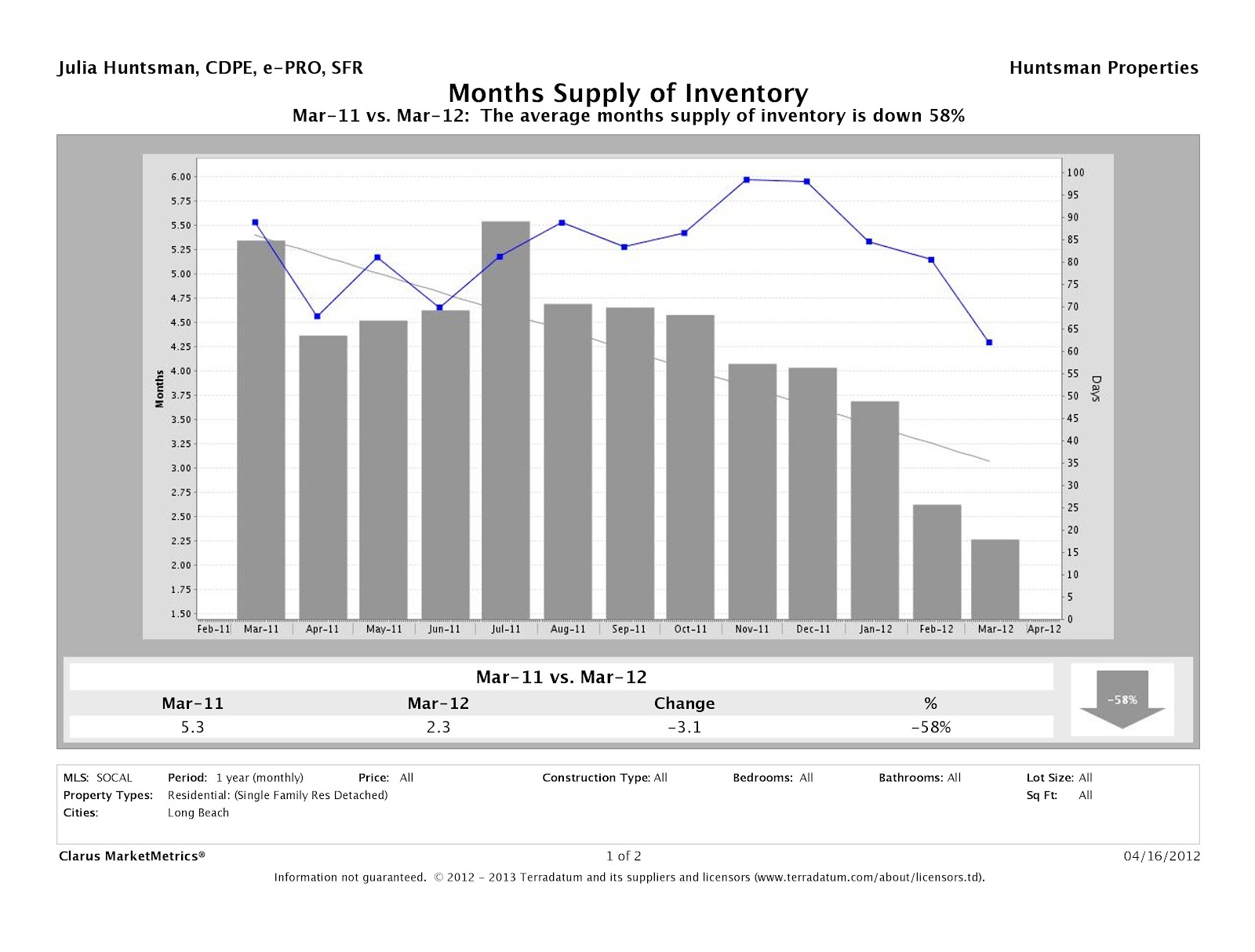
Did you know that Long Beach and surrounding areas have less than two months of inventory?
This chart covers up to 2011, and the trend of multiple offers in the lower price ranges is even stronger in 2012.
Think you can't sell?  Think again, and call me.


5/22/2012

Long Beach Parks Summer Concerts for 2012


Now that "House" is over and gone forever, there's no reason to not remember the summer concert schedule for the Long Beach Municipal Band.
Long Beach is lucky to have such a music resource, not every city can maintain its own group of musicians.  Plus, Larry Curtis, the band conductor, used to be the conductor for my high school band eons ago, so that's another reason I like this band.
Week 2:
Week 1: July 10 TBD
July 5 Marine Stadium
July 6 El Dorado Park West
July 11 Los Cerritos
July 12 Marine Stadium
July 13 El Dorado Park West
Week 3: Week 4:
July 17 TBD July 24 TBD
July 18 Los Cerritos Parks July 25 Los Cerritos Parks
July 19 Marine Stadium July 26 Marine Stadium
July 20 El Dorado Park West July 27 El Dorado Park West
Week 5:
July 31 TBD
August 1 Los Cerritos Parks
August 2 Marine Stadium
August 3 El Dorado Park West

http://www.longbeach.gov/park/recreation/lb_municipal_band.asp


5/21/2012

Don't Overlook California CO Detectors

Carbon monoxide is colorless, odorless and toxic. It's called the "silent killer" in homes because some victims are not even aware that the deadly condition exists.
In California, detectors must be installed:
(1) For all existing single-family dwelling units on or before July 1, 2011.
(2) For all other existing dwelling units on or before Jan. 1, 2013.
Where should they be placed?  For minimum security, a CO detector should be centrally located outside of each separate sleeping area in the immediate vicinity of the bedrooms, and  should be located at least 6 inches from all exterior walls and at least 3 feet from supply or return vents. I have even heard that during escrow, some appraisers will "call out" a missing detector on their appraisal. If you're a homeowner or landlord, don't wait to comply with this requirement now.
Property owners must be concerned about unmaintained furnaces, water heaters and appliances that can produce the deadly gas. Other sources could include leaking chimneys, unvented kerosene or gas space heaters and even exhaust from cars operating in an attached garage.
The Environmental Protection Agency suggests the following to reduce exposure in the home:
  • Keep gas appliances properly adjusted
  • Install and use an exhaust fan vented to the outdoors over gas stoves
  • Open flues when fireplaces are in use
  • Do not idle your car inside a garage
  • Have a trained professional inspect, clean and tune-up central heating systems annually
Lower levels of carbon monoxide poisoning can be mistaken for the flu.
It's also possible to buy them in combination with a smoke alarm. Read more at HouseLogic.

5/10/2012

Investor Buyers are Making a Difference in This Market

Investor buyers, do you know you make up about 27-30% of the current buying market?  Most investor buyers are looking to hold onto their properties for a while--only 5% of properties purchased last year have been re-sold.

The second home market surged in 2011, according to data from the 2012 NAR Investment and Vacation Home Buyers Survey. The combined market share of investment and vacation homes rose to the highest level since 2005.

Investment home sales in 2011 jumped 64.5 percent over 2010. Vacation home sales climbed seven percent, year-over-year, and accounted for 11 percent of all transactions last year.

5/09/2012

How Many Single Family Homes Under $300,000 in Long Beach?

Since this Spring of last year, the last time I wrote this post, not as many as last year.

The great majority of residential properties included here are single family houses and condominiums; the list also includes lofts (a separate MLS designation), own-your-owns and co-ops. The grand total from SoCalMLS is 340 listed as "active", regardless of selling condition (short sale, REO, probate, etc.), or the amount of HOA dues in the case of common area properties.

This inventory is quite different from one year ago when there were a total of 618  on the market.

The breakdown includes the following:

5/08/2012

Increase in April Home Sales Prices for Long Beach, and Nearby Cities

Based on MLS data, 10K Research&Marketing
Long Beach home sellers may finally take heart at some continuing good news. While the citywide accumulated median and average price for single family home sales continues to decline from last year, the April 2012 comparison to the same time last year actually shows an increase in median and average sales price:  Median - from $374,500 to $381,000;  Average - from $421,796 to $424,441.

The average price from April 2011-April 2012 for condos and townhomes also shows a 10% increase, from $211,280 to $232,676. 

As above, the "rolling" 12-month calculation for both categories still shows a decrease in prices, however.  With the increase shown in pending sales compared to last year, more buyers are buying. But the 50% cut in inventory levels say that many possible sellers have yet to decide to put their properties on the market.  In fact, Long Beach had the highest number of closed sales (226) in April over all the other 60+ cities in this report area.

4/27/2012

6 Don’ts After You Apply For A Mortgage

I learned a long time ago that “common sense is NOT common practice“. This is especially the case during the emotional time that surrounds buying a home, when people tend to do some non-commonsensical things. Here are a few that I’ve seen over the years that have delayed (and even killed) deals:
  1. Don’t deposit cash into your bank accounts. Lenders need to source your money and cash is not really traceable. Small, explainable deposits are fine, but getting $10,000 from your parents as a gift in cash is not. Discuss the proper way to track your assets with your loan officer.
  2. Don’t make any large purchases like a new car or a bunch of new furniture. New debt comes with it, including new monthly obligations. New obligations create new qualifications. People with new debt have higher ratios…higher ratios make for riskier loans…and sometimes qualified borrowers are no longer qualifying.

4/16/2012

Long Beach Needs More Single Family Homes on the Market!

Long Beach Inventory
Long Beach--two months inventory
For the last year, since March 2011, the Long Beach median prices have been jumping around.  The median prices for listings and sales have gone up and down for the city, overall. These charts show the overall market, which varies in price quite a bit, and lumps all distressed properties in with regular sales.  In March of last year, the median price was $365,000, and for March of 2012, the price is $369,900--while the "sold" prices have actually gone down. But what is in escrow? That's where the prices in 1-3 months may be showing an upward trend, because sales activity has picked up a much faster pace:  the number of single family properties (both distressed and regular sales) in escrow is up 40%, and is at the highest number in the last 12 months.

Long Beach Median Price march 2012
Median price for listings is up again in Long Beach
And another thing is very clear: in checking with Long Beach, Lakewood and Cerritos, all cities are down to two months or less of inventory for single family houses. The second chart clearly shows a downward trend in numbers of listings on the market since last summer.

That means if no new listings came on the market, the current inventory would be sold in approximately 2 months at the current rate of sale.
Sellers should start contacting their real estate professional now to review their best position for selling, because the buyers, both investor and owner-occupant types, are buying!

I am available to help you as your real estate professional, just give me a call, e-mail me, or contact me through my website at www.juliahuntsman.com.

4/12/2012

California Foreclosure Study by San Francisco Assessor

This information just came in this afternoon to me from Duane Gomer, a real estate trainer active in the real estate market:
The San Francisco Assessor commissioned a foreclosure study during 2009 and 2011. The results are revealing and stunning to me and I’ve studied this market for decades. For example: 1 – 99% had irregularities, 2 – 84% had violation of law, 3 – 75% had issues with the assignments of the trust deeds, 4 – 84% had problems with the substitution of trustees, 5 – 59% had evidence of backdating, 6 – 45% the foreclosing party had never been assigned the loan. The Assessor’s conclusion: The California Non-Judicial Foreclosure System is “utterly broken” and needs repair.
Just as further comment, the California non-judicial foreclosure law and procedures is explicitly spelled out in California code. 

This study of 382 San Francisco homes between 2009 and 2011 was conducted by a Newport Beach-based company, and a February 2012 Orange County Register article goes into more detail here.

3/27/2012

Number of FHA Qualified HOAs Falling Drastically

This afternoon I was sent a list of FHA-approved condominium complexes for Long Beach.  They now currently number 34, with two approvals expiring in April, leaving 32 for all of Long Beach.  This is a huge reduction in number compared to a few years ago--these approvals are dropping off for two reasons: HOAs don't realize the requirements have changed or that their approval has expired and that they must renew again, or the HOA complex's financial circumstances don't currently meet FHA guidelines.  But I believe many complexes fall into the first category.

If you are an HOA member, or know someone who is, think about this: If your complex is not approved for FHA-HUD loans, you greatly reduce the number of approved buyers who can bring an offer, thus probably delaying the selling date of your property.

If you are a buyer with an FHA approved loan (especially one being used with certain buyer assistance programs), your selection is now greatly reduced because you simply will not be able to buy in a non-FHA approved condominium complex.

Property owners, you should take active steps to look into this issue.  With today's loan qualifying requirements, FHA loans are accessible for many 1st time and repeat buyers, and in the future they will become even more critical as former owners of distressed properties re-enter the market.

So you think you're going to keep living there, and it doesn't matter?  What if you would like to get a reverse mortgage?  They require your complex to be FHA approved.

Yes, there are lenders willing to qualify your association during escrow, but don't wait until then--it's a much longer process, and the buyer could decide to find another property.

Or the alternative is, if you're a buyer, be prepared to use a lender not of your choice, but one of the few who can give you a similar loan without needing to go FHA. In that case, call me, and I can send you to the right place.

But owners, remember, there are still FHA approvals required for reverse mortgages, therefore contacting your Board of Directors should be at the top of your agenda.
Web Statistics