10/01/2007

Market Activity in East Long Beach 90815 for September 2007

According to residential resale transactions recorded at the Los Angeles County Recorder's office for August, there were 306 transactions in zip codes 90802 through 90815--a decrease of 18% in sales for the same period in 2006 for the same area which shows 372 transactions.

California Association of Realtors reports a 27.8% decline statewide in numbers of sales for August compared to the same period last year, and an approximate 5% decline in median sales price.

Locally, though, it appears that all trends as showing in the Southern California MLS are down except the price:

Taking just the one zip code 90815, generally considered East Long Beach and including the varied housing characteristics of Los Altos, La Marina, Park Estates, Bixby Hill, Artcraft Manor, College Park West, and Stratford Square neighborhoods, 17 single family homes closed in September selling at 95% of the list price at an AVERAGE (probably very close to the median) price of $754,911 after an average of 55 days on the market--a decrease of 23% from September 2006.

The 90815 area for September, 2006, 22 single family homes closed at an average of $711,318, at 97% of the list price, after an average of 74 days on the market

For the 90815 in 2003 there were 39 sales, after 19 days on the market, selling at 99% of the list price at an aver sales price of $497,038. 2003 is the year showing the most recorded transactions from the Los Angeles County Recorder for the 11 zip codes mentioned above in the last 5 years at 423 total transactions.

The 90815 house at the right does not fit the average sale picture above--It features many interior upgrades including kitchen and bathrooms, has an earlier room addition which makes a den or a 4th bedrom, yet remains on the market after a year. The current asking price is $668,950--it's a great house for a young family because it's within walking distance to the elementary and middle schools, near shopping and the airport. If you would like to know more contact me, or find this property (it now has a little tree in the front) here.

'Voice this!

9/24/2007

Sales Activity Comparisons for Long Beach and Cerritos

The number of houses selling over $1,000,000 in the 90803 zip code now equal about half of total sales of single family homes during July and August. While there are those who say that this fact skews the overall median price, it's still a fact that there is a market in this price range where it did not exist a few short years ago. In August, the AVERAGE sales price of 17 closed escrows, per the MLS, was $1,283,876 at an average of 64 days on market with the selling price about 91% of the original list price. In July, 25 properties closed escrow after an average of 68 days on the market at an average selling price of $1,408,653, at 92% of the original list price. The lower end of sales in this area was around $600,000, and up.

If these prices shock you, just look at the blue-footed doobie for a minute.

The story for July and August of 2006 for 90803 was almost the same for average price and number of sales (18 for both months), but the average time on market was MUCH longer: 124 days on market in July and 97 days on market for the average sale of $1,175,000 in August.

The story in Cerritos is similar: August of 2006 saw 53 days on the market, July was 42 days on market. August of 2007 was 26 days on the market (half the time to sell from one year ago) and July of 2007 the average sale time was 29 days on the market.

For both years the sale to list price percentage is higher than Long Beach--in July of 2006 it was 97% of the original list price and in July of 2007 it was 95% of the original list price. The average sale price has declined in those two months to $715,789 for August and $747,754 for July of 2007.
If you still want to be in Long Beach near the beach, the house at the right is on the market for $689,900 in Belmont Heights. For more information, call me or go to www.juliahuntsman.com and find 261 Grand on the property search engine.

'Voice this!

9/20/2007

Old Saying in Real Estate: "First You Have to Sell It to the Buyer and Then ...


... you have to sell it to the appraiser." In a rising market appraisals are usually not a cause of concern, but the market of the last two years is seeing a return of cautionary words about knowing the appraisal process. This is where sellers are smart to choose agents who provide them with realistic comparables when listing their property, and this is where it's smart for buyers to work with agents who are familiar with their prospective new home.

Sellers who bought recently may not be happy with the actual rate of return on their new purchase, particularly if they've refinanced lately, or took out a home equity line, or had a 100% mortgage to begin with. Sorry, but your equity won't be so great, if any. Furthermore, in the words of a local loan representative who sent me an e-mail on appraisals today:
"The appraisal process often confuses consumers and loan officers. They may feel that their home is worth a higher dollar amount, and so the appraised value doesn't always make sense to them or sales staff because there has been so much time and effort invested in the file. It is important to know that the appraiser is completely independent from borrowers, buyers, sellers, and Real Estate Agents, and that the guidelines to which they adhere are dictated by the Uniform Standards of Professional Appraisal Practice (USPAP) and Fannie Mae. In most states, the mortgage lenders must also disclose the purpose of the appraisal, as each transaction carries its own set of rules. In essence, these important guidelines help appraisers put a fair market value on homes based on comparable sales in the same area, and the home must be bracketed in size and value. The most important feature of a home is location, location, location."


It's not uncommon for sellers to think their lovely home is worth more because of $50,000 invested in certain upgrades, but that depends on the age of the home. Per our friend from Wachovia, "the upgrading or remodeling of an older home is rarely reflected in full in the final appraisal" because much of the total remodel cost usually involves demolition and upgrading of the basics such as plumbing and wiring. Upgrades in a very new home would get a higher return on the investment because they are an addition to the cost of building the new home. The value of those upgrades will depend on the local value of other recent sales with similar upgrades.

If you have an all cash buyer and no lender appraisal is required, you may or may not deal with an appraiser because the buyer may still want a 3rd party opinion.

A most difficult thing in a transaction where the buyer is obtaining a loan is to have the appraisal reviewed prior to closing--last minute questions can delay the closing. The best of all possible worlds is for sellers to realistically price their properties for their area.

(And why is there this picture with the dog? Because I couldn't find a photo of an appraiser.)

'Voice this!

9/17/2007

Local Water Use Restrictions

The City of Long Beach has declared a water shortage and issued revisions to the municipal code concerning water use which ought to be of interest to all Southern California cities.

Record low rainfall and an 8-year drought in the Colorado River watershed, used by much of Southern California, along with other impacts such as a federal court Endangered Species Act ruling on August 31st, necessitated new rules for the City of Long Beach:

Washing driveways, sidewalks, parking areas, patios or other outdoor cemented or paved areas with a garden hose, unless it is attached to pressurized water broom;

Irrigating any landscape with potable water between 7:00 a.m. and 6:00 pm;

Irrigating any landscape more than three days per week.


The City imports almost half of its water and states a water supply shortage is imminent without immediate conservation, and is mandating the use of water pressure devices on all hoses. Just click on the link above for complete information.

9/11/2007

New Property Search by Map

Find the latest technology now offered through
our Southern California MLS service. Easy to map, easy to search by zip code, map area, and city. Different ordering sequences allow searching by days on market, square footage, bedrooms, baths, plus more selections.

Go to www.juliahuntsman.com and click on "Pinpoint Map Property Search" where you will find a screen like the one at the right.

Take advantage of other links there, too!

For free e-mail property updates directly from our MLS, just fill out your information on my Guestbook form, and I will set one up that goes directly to your e-mail address. This saves time and allows for very focused searches.

Know Your Rights if You Are in Pre-Foreclosure


It's an unfortunate fact that certain loan borrowers have been unable to make their payments. On this blog there are many searches about information on foreclosure and pre-foreclosure.

If you're in this situation, please see my earlier post What Happens If You Are In Foreclosure?.

It's important for you to know that certain California statutes regulate the sale of homes on which a Notice of Default has been filed, that if you list your home with a California agent you should make sure your agent is aware of using the Home Equity Sales Contract form when a buyer presents an offer. This form specifically addresses particular issues as required by the California Civil Code Sections 1695-1695.17 which are designed to protect the seller from fraud and deception by unscrupulous buyers. Among other things, a sales contract under these circumstances would include the following language to prevent you from signing over the rights to your home under undue pressure:

"NOTICE REQUIRED BY CALIFORNIA LAW Until your right to cancel this contract has ended, _______ or anyone working for _______ (Name) (Name) CANNOT ask you to sign or have you sign any deed or any other document."

Read the Code sections linked above (they're not that difficult to go through) because they carefully spell out what the equity purchaser (your buyer) must do if you already have a Notice of Default filed on your property. An equity purchaser convicted of fraud under these laws is subject to damages and other penalties including jail time, and the seller has certain rights to bring action. If you are in doubt about someone you are dealing with, or have questions before you list your home, please take the time to get a second opinion from a qualified REALTOR, or seek advice from an attorney who specializes in real estate law and foreclosures.
October 12, 2007 addition from October CLTA News concerning rescission of a sale of a pre-foreclosure property:

"REMINDER --- DISTRESS SALES ARE HIGHLY REGULATED

"Homeowners facing foreclosure and buyers wanting a deal would seem a perfect match. But these matches face obstacles that both buyers and sellers may not fully understand. This is because the California Legislature stepped in a few years ago to crack down on fraud and created a whole new set of laws dealing with the sale of property in foreclosure. The law provides far-reaching protection to homeowners facing foreclosure. Once a notice of default is filed the law applies and sellers have specific legal protections, including the right to cancel a contract to sell up to five business days after signing a contract to sell the property. Not only can a seller cancel the contract before the sale but under certain circumstances the owner may rescind the sale within two years if a court finds the sale unconscionable. In addition, a court may award the seller damages and the purchaser could be criminally prosecuted.

"A representative of the seller is also treated harshly if they do not comply with the law. These representatives must have a valid real estate sales license and a bond. [MY NOTE: USING THE REALTOR'S HOME EQUITY CONTRACT FORM CORRECTLY ADDRESSES THE BOND ISSUE.] Both the purchaser and seller must be given a statement by the representative that they have the license and bond. Failure to comply means the seller may choose to treat the sales contract as void and can seek damages. There is some relief from all of these pitfalls. If a purchaser is going to use the property as their personal residence or the purchaser is the spouse or blood relative of the homeowner then the law does not apply. The bottom line in all of this is that both buyers and sellers and their agents should be aware of the law. With all of the attention devoted to sub-prime mortgages and foreclosures it is likely that the failure to strictly comply with the law will lead to serious title problems."

9/07/2007

Southern California's Hot Weather Breeds Mosquitoes


Last year's news on the West Nile virus is really still with us, so much so that the Department of Public Health for the State of California recently published a bulletin about standing water and green pools. It's mainly directed towards real estate managers and other property managers who might be concerned with vacant properties and unattended pools, but standing water could be a problem in a lot of locations, such as a chronic low point at a street intersection which catches the neighbor's lawn runoff.
"Standing water" in this bulletin is what has been in a pool for more than 7 days, it supposedly takes 7-10 days for "green pool" mosquito eggs to hatch.
It's easy enough to check for tubs or pots or other small containers around your property and overturn them if they are collecting water. Better yet, put them out of reach of falling water. Potted plants that are overwatered are also an ideal site for mosquito breeding--especially in very hot weather.
If a green pool, or stagnant fountain is around you, you can help by calling the number in this bulletin: "You can find your local agency on the California WNV website (www.westnile.ca.gov) on the right side under 'locate your local mosquito and vector control agency' or by calling 1-877-968-2473 (1-877-WNV-BIRD)."


9/04/2007

Can You Buy on $100,000 Income? Yes!

"The minimum household income needed to purchase an entry-level home at $504,080 in California in the second quarter of 2007 was $101,550, based on an adjustable interest rate of 6.29 percent and assuming a 10 percent down payment. First-time buyers typically purchase a home equal to 85 percent of the prevailing median price. The monthly payment including taxes and insurance was $3,380 for the second quarter of 2007." (California Association of Realtors, August 29, 2007.)

With downward changes in the market in some areas, the buyer affordability levels become a little more positive. The percentage of households that can afford to buy in today's market has increased one percent from the 2nd quarter last year to 24%. The index goes up a little more for those who can find that 100% loan that matches their buying profile, or for those who have a larger down payment than 5%.

In today's search in the MLS for just 3 zip codes in downtown, Belmont Heights/Shore, Bixby Knolls/California Heights areas of Long Beach (90802, 90803, 90807), a total of 203 condos and houses over 2 bedrooms came up under the asking price $504,080. On your monthly payment, add in HOA dues which are usually $200 at least for condominiums. For single buyers looking for lower prices in the $300,000 range, this figure does not include one-bedroom condominiums.

I am meeting quite a few people paying $2500-$2800 a month in rent. These are the people balking at paying perhaps a higher mortgage + taxes + insurance payment, but they're receiving no tax deduction benefit and no home equity. Tax deductions include mortgage interest, property taxes, plus other deductions (consult your accountant), according to your current tax margin which for a lot of people is about 35%. What a renter has, in a gradually shrinking rental housing inventory, is a 30 or 60-day notice to find a new home, and no long-term benefits.

Here you have at least 203 opportunities to buy in these 3 zip codes alone--why not search out all of your opportunities while you can look without pressure? It's much easier than the other scenario of limited time and uncertain choices.


8/30/2007

CAR: July's California Median Home Price at $586,030

While the sales volume continues to decline, the median price in this state remains strong. July's median price for single family homes (excluding condominiums) is even a little higher than this time last year, according to the California Association of Realtors.

Partially responsible for this decrease in sales are the tighter lending guidelines--for buyers looking for 100% loans, they are much tougher to find. For all buyers, higher FICO scores are demanded, and some loan programs have disappeared all together. These changes affect the entry level buyers the most, as even a 95% loan-to-value program may be difficult to find.

110 out of 371 communities/cities in this state showed an increase in their median price compared to one year ago. Click on the title link of this article and see the 10 highest priced communities in the state, and the 10 with the greatest increase.

Condos have increased overall to a median price of $434,640, a 2.4% over one year ago.

Real estate is local, so median prices don't reflect changes up or down in other communities on a month-to-month basis.

Important to keep in mind: “It is important to note that decline in sales is not driven by weakening economic conditions ... Rather, the statewide and national economies continue to move forward, with no recession on the horizon at this point in time."

8/22/2007

Vacation or Second Homes

Sometimes, actually a lot of times, people think they don’t have the ability or resources to accomplish a certain goal, and then it truly becomes unattainable. A timely quote for this might be, “People don't plan to fail; they fail to plan.” (This was most recently said by a REALTOR in New Jersey, but don’t think he was the first.)

First, you have to ask yourself what you really want—possibly this will lead to workshops on goal-setting, or minor, then major, soul searching, then therapy. We’ll leave that up to you, but we do recognize that for most people making transitions can take time. Fast forward and move onto your second home strategy.

A down market of new and existing home sales spells opportunity, and the IRS allows for certain benefits, if you plan well. Do you plan to make it your future retirement home? Then area will be especially critical. Have you factored in your upkeep and expenses for maintaining a second home vs. an annual summer rental? Are you living in the desert and wishing for ocean breezes—if you’re calling on a coastal listing and it’s 108 degrees where you live now, you might be calling out of desperation (see “Fools Rush In” at the link) rather than a good long-term plan.

Have you talked with your tax accountant or attorney first to be aware of how you can gain or lose with the IRS—how many days you may or may not rent out the second home, how to avoid the Alternative Minimum Tax or minimize it, or how your Subchapter S corporation through your business can benefit you. Have you thought about your 1031 exchange and capital gains factors if you decide to turn this into an investment property, or vice-versa? If you have an vacation investment property you may be able to exchange it or convert it later to personal use:

“A section 1031 exchange lets you sell one investment property and defer the capital gains if you put the proceeds into another. You'll have to rent out that new property, too, to qualify for the tax deferral. But after renting the property out for a year, you can convert it back to personal use. There's still no tax until you sell.” (Jeffrey Schnepper is a New Jersey lawyer and CPA, personal finance columnist and the author of several books on tax strategies.)

You could be considering a family home, a smaller cabin, a condo or townhome or a duplex or a triplex near the beach where you could be gaining income on the other units. The initial planning stages may put you through some work, but it’s better than buying a property and later losing money on it because you bought it in that dream like state while you were on vacation already.

8/14/2007

Not All Pricing Trends Are Down ...

. . . in fact, some are up. Writer Kenneth Harney, based in Washington D.C., reported August 12 about median price increases in Chevy Chase-Bethesda areas, by zip code.

In today's Los Angeles Times, a convenient interactive zip code finder is an interesting feature for finding median prices comparing July 2007 to July 2006. For instance, 90803, a Long Beach area of affluence, ocean views, and mixed single family residences, residential units, and condos, adjacent to the shoreline and a few blocks in, shows a median price increase from under $1,000,000 last year to over $1,000,000 this year, and an increase in the number of sales as well. Go to nearby zip code 90815, an area of mostly single family homes near a shopping center, schools and local libraries, and see the price and number of sales change upward only slightly since last year. On the other hand, Cerritos zip code 90703 has seen an 11% decrease in number of sales with a 3% median price decrease from $690,000 to $668,000 this year.
North Long Beach area 90805 has an 11% decrease in price and an almost 40% decrease in number of sales. This would be more the land of opportunity for the right buyer in the $400,000 price range for a house.

You may find, however, that data is different depending on which source you use: See the zip code chart published in Sunday editions of the Los Angeles Times.

While certain areas are more connected to subprime loans than others, an area of affluence is still not totally immune, since some borrowers stretched themselves to the limit to get into their new home of choice.

According to the Los Angeles Times article using data from Dataquick, "Los Angeles County's median price rose 5.3%, to $547,000, and sales slid 23%, and Orange County's median was flat at $640,000, as sales fell 19.8%."

8/12/2007

Volatility in the Credit Markets

The world of loans and finance is like a global pile of pick-up-sticks, and this last week demonstrated how one move rolls everything. On August 9th France's largest bank BNP Paribas halted withdrawals on the investment funds it said could not be fairly valued because they held subprime loans. The European Central Bank and Federal Reserve in the U.S. each added money to their own systems in response to the European banks' sudden demand for cash over the subprime loan market problems here.

The analyst at SCME Mortgage Bankers tells us that actually what you don't hear in your television news reports is that subprime loans themselves are not the problem: subprime loan delinquency rates are close to the delinquency rates on FHA/VA loans. When was the last time you heard about HUD-insured FHA loans in the media?--those low down payment loans which have been around since the Depression. Both types of loans lend to borrowers with lower FICO scores and other credit profile issues.

The difference is that the subprime loans are backed by bonds, and some hedge funds have raised capital to buy those bonds, and also borrow additional funds using that same capital, to buy more bonds through leverage. With a decrease in the value of the bonds, such as is now going on the subprime market, these hedge funds are receiving margin calls, meaning the lender wants its money. If the hedge fund cannot meet the demand, it suspends withdrawals. Some mortgage sources have paid out cash to meet the margin calls, and eventually are having to close their doors, American Home Mortgage--a strong and solid lender--being a good example. Banks which lent money to the hedge funds are now in the last few days backed up by deposits from the country's central bank, thus creating news when we read about the European Central Bank loaning $130 billion to its banks, and the Federal Reserve adding $24 billion to the U.S. banking system.

What has happened in the subprime loan market is a much larger story than a short spot on the 6 o'clock news. It's tied into our system of investing, who is regulated and is not regulated, and what happens when market factors change.

For another look at the current situation, click on this Singapore post.


8/09/2007

What About Taxes on Short Pays And Foreclosures?

In case you're involved in either one of these situations, it's important to know you may be paying the IRS some money.

A "short pay" is where you were soon going into foreclosure, or you knew you were have difficulty in keeping up with your payments, and fortunately, you were able to sell before the inevitable occurred. The bank took back your loan for less than you owed on it, because you just weren't able to sell your property for more than it sold for. So if you owed $400,000 on your loan balance and the bank agreed to settle at $380,000, the bank lost $20,000 on their loan. Or, in the situation where you did go into foreclosure and the bank still lost money on their loan because they couldn't ultimately sell the property high enough to recover their loan amount, they are still faced with a money loss situation.

In either of these events, you could face a capital gain or loss or relief of debt amount for reporting on your tax return. There are many factors involved, such as how the property was held, i.e., whether or not it was your personal residence or held for resale, and what your basis was in the property, will be important information. Whether it was "recourse" or "non-recourse" debt is significant.

The important thing to know is that your tax advisor is all important in this situation. The law requires lenders to issue a 1099, but you shouldn't assume that the amount you see is the full amount of debt that you owe taxes on. This is probably not the time to do your taxes yourself, but instead seek full advice from a competent tax advisor. More information is available from the IRS.

8/05/2007

How to Read Your Mortgage Documents

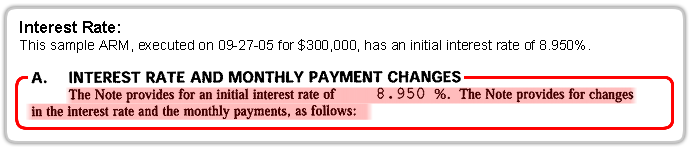
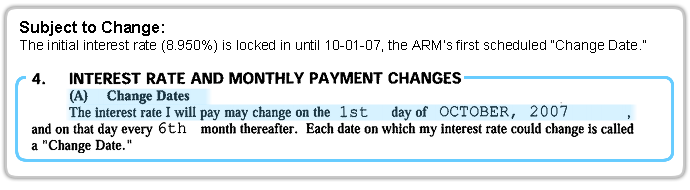
This is a great article from YOU Magazine specifically relating to adjustable rate mortgage documents. The links show very explanatory illustrations:

Every day you read another horror story about the subprime collapse. Most of the stories focus on the negative impact Adjustable Rate Mortgages (ARMs) will have on subprime borrowers once their interest rates reset. But what's often unreported in these news pieces is the fact that the risk extends far beyond subprime borrowers. That's right. Anyone with any ARM that is scheduled to reset may be faced with an interest rate increase of up to 2.00%-3.00%, even A-paper borrowers.

This article is not designed to scare you or add to the flood of media hype on this topic. To the contrary, our goal with this interactive article is to empower ARMs consumers with the knowledge they need to avoid becoming one of the millions of borrowers expected to foreclose in the coming years. Continue reading and you will learn how to interpret your mortgage documents, calculate your increased rate, estimate your increased monthly payment, and determine what you may need to do to avoid potential problems. We'll also show you actual loan documents and explain some of the confusing legalese that can easily lull borrowers into a false sense of security. Even better, print out this article and discuss and double-check your calculations with your mortgage professional. This will help to put your mind at ease because you'll know exactly where you stand with your mortgage.

These
sample ARM documents may differ from those found in your mortgage, but they contain the basic ingredients discussed in this article and are typical of all ARMs documents, with the exception of Option ARMs (which YOU Magazine will feature in a future article).

Initial interest rates on ARMs are generally locked for a predetermined period that can range anywhere from 12 months to 120 months. When the predetermined fixed-rate period of the ARM expires, the interest rate is then subject to change based on a combination of three factors.

The first factor is the
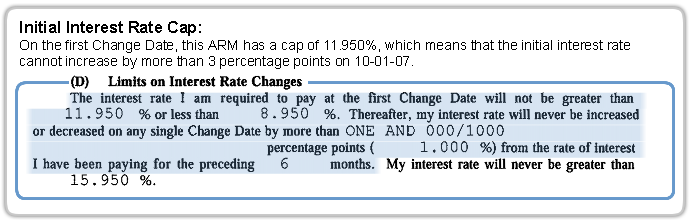
initial interest rate cap that was put in place at the time the loan was originated. This interest rate cap typically ranges between 2 to 5 percentage points, depending on the terms of the note. The higher cap of five points is generally in effect for loans in which the initial fixed-rate period is five, seven, or ten years. This means that if your initial interest rate was 6.00%, the maximum interest rate your loan could adjust to upon the first adjustment would be 8.00% or 11.00%. The initial interest rate cap will be in effect for 6 to 12 months before it is subject to adjust or reset. The cap on all subsequent adjustments to the interest rate should be either 1.00% or 2.00%.

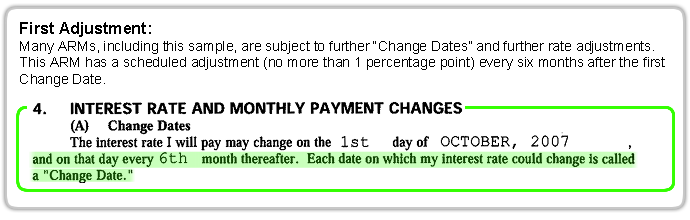
For those borrowers with a subprime loan, the pain of the first adjustment will be followed with a potential increase in rates again within six months of the
first adjustment.

In addition to the cap, there are two components that determine the interest rate when the ARM adjusts. The first component is what is known as the
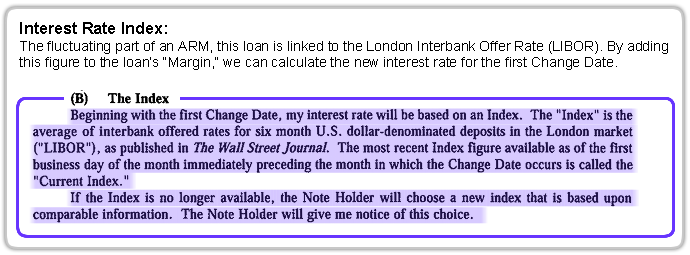
interest rate index. The index is the fluctuating component of the new interest rate and is based on, or tied to, any one of several indices tracked by the Wall Street Journal, including, but not limited to: the London Interbank Offer Rate (LIBOR), U.S. Treasuries, as well as the Prime Rate.

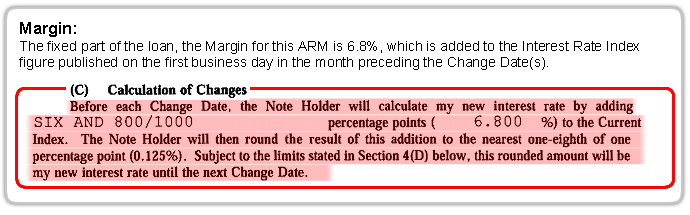
The second part of this equation is what is known as
the margin. The margin is the fixed number that, when added to the index, determines the interest rate the borrower will be charged upon adjustment.

This means that, if the index tied to the mortgage is the Six Month LIBOR, which, let's say is approximately 5.38%, and the margin for a borrower was listed at 5.00, the newly adjusted interest rate could be 10.38%! If the borrower's original interest rate was 6.50%, and the loan carried a 3.00% initial interest rate cap, this loan would adjust from 6.50% to 9.50% at the first adjustment. If the index remained the same at the time of the next adjustment, the interest rate would adjust to 10.38% when the loan resets.

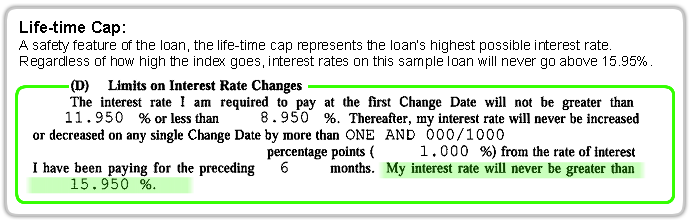
It's important to understand that, while the interest rate will never be higher than the
lifetime interest rate cap, this number itself can be relatively high – the life-cap in our sample ARM is 15.95%. For borrowers who are unable to refinance due to changing circumstances, this means that rates could reach the maximum level the loan allows!

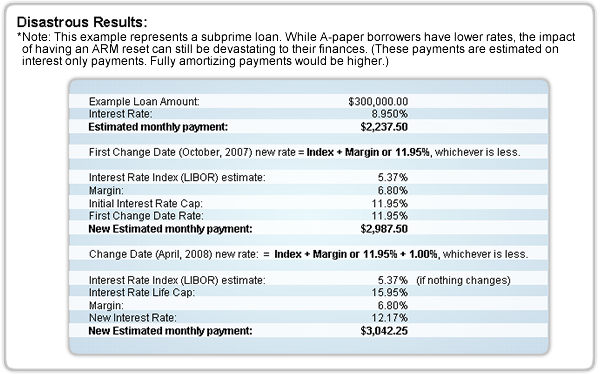
Let's apply this to a sample ARM holder and see the results. For someone with a mortgage in the amount of $300,000, the interest costs alone could increase anywhere from $6,000 to $9,000 a year. This translates into a mortgage payment increase of $500 to $750 a month just in interest. For anyone struggling to keep current on their monthly payments, such an increase could have
disastrous results.

You may be wondering why anyone would take on an ARM in the first place. Despite the scenarios we've outlined here, ARMs, as a product, are not evil by design. It's true that ARMs are currently experiencing an increase in interest rates. But in a market with falling interest rates, ARMs placed at that time will experience falling rates as well, without having to refinance. Because of this feature, ARMs hold an important place in mortgage financing. In many instances, borrowers have qualified for a larger home or have been offered a lower payment for a similar amount financed because of the availability of ARMs.

Even though underwriting standards continue to tighten as a result of the subprime fallout, it does not mean that you won't qualify for an A-paper loan. Many people who may have been limited to subprime products in the past are now qualifying for Expanded Approval (EA) loans through Fannie Mae. Borrowers qualifying through EA criteria may also have the ability to qualify for Timely Payment Rewards (TPR), a program that allows for automatically reduced interest rates, without refinancing, on a 30-year fixed rate product, provided the borrower makes payments on time for a period of 24 consecutive months within the first several years of the mortgage. In most cases, borrowers with credit issues benefit more from an EA loan than from adjusting with their subprime ARM or originating a new subprime loan. Talk to your mortgage professional today about these options if you have any questions or just want more information.

Obviously, it is very important to understand the complexities of how any of these financial instruments work, as well as any potential implications the borrower might face throughout the life of the loan. Congress, many state legislatures, and the Federal Reserve are currently reviewing how mortgage companies present ARM disclosures to borrowers at the time of application to ensure borrowers better understand the mortgage process. Until then, it's up to you to protect yourself and your family. Don't get caught off guard. Pull out your ARM loan documents and use the interactive features of this article to estimate the changing cost of your ARM. If you don't like what you see, or you're still having trouble working out the numbers, make an appointment with a mortgage specialist right away.


Article also courtesy of Doug Davis at Clarion Mortgage.

8/01/2007

Plusses and Minuses of Long Beach Condo Conversions

Bluff Park condo conversion in Long BeachNational homeownership by the end of the Clinton Administration supposedly rose to about 65%, the highest ever recorded. But, according to the City of Long Beach within the last few years, during that same time period, that was about how many non-owners were living in Long Beach. In other words, we were the opposite of the national picture. According to the Long Beach Business Journal, July 31, 2007 edition, the local situation may be close to reversing itself. A total of 152 conversion projects have been approved, reducing Long Beach's supply of rental homes by 2,133 since 2000.

No trend is perfect: The opportunity for homeownership has decreased homes available for renters. With long term population projections in the state predicting that the demand for housing will continue far into the future, there will continue to be a demand for housing for both owners and renters, and right now there's a demand for rental housing, and there may be some future restrictions on conversions to allow for a balance. The newly converted units are often smaller and priced lower--800-900 sq ft for a 2 bedroom--than the original condos. Some lenders need specific information on final conversion date and the current owner occupancy level, if any, to underwrite financing. The smaller 2-story buildings may not have elevators, however, remodeled new interiors with new appliances, for some buyers, may be a compensation for these other factors. Buyers should know that in dealing with a smaller building, they will also be a dealing with a smaller risk pool in their Association funding. The unit at 2138 E 1st St. is an upper floor 2 bd/2ba, 775 sq. ft, $238/month HOA dues, ocean view, in a historic district, and has been listed and on the market for 440 days, per today's MLS activity, in a building of 10 units where all others have now sold, list price $417,500. There are others on the market at lower prices than this one.
For a list of condo units in this area, please let me know, they're easy to e-mail.
Do tenants need some protections and acceptable and affordable housing stock, yes. Do buyers need lower-priced units and opportunity to buy in a selection of areas, yes. The story is not as completely simple as this, there are multiple effects and ramifications on each side pertaining to job impact, higher developer fees, higher rents, and units sitting on the market, but the City of Long Beach wanted more owner-occupied housing, and that is what is happening.

7/27/2007

Best Places To Live

Every year editorial staffers get together various criteria to decide on the 10 best places to live in the country. Your criteria may not be the same, however, Money Magazine's annual article is a good way to find an overview of statistics and information, and make some comparisons.

Cerritos, for instance, has one of the top-rated high schools in the country whose students' scores far exceed the national average and outperform schools in the top 10 cities, it provides many amenities for its residents, but is not one of the top 10. For one thing, the median housing price is much higher there than the 10 selected cities. And, typical of Southern California, the air quality is lower compared to New Hampshire or Florida locations. However, Claremont is Number 5 on the 10 Best Places ot Live list, so air quality is not the only issue. And Lake Mary, Florida, (Number 4) has twice the diabetes rate than Cerritos.

But other things that change are insurance premium costs, property tax rates, crime rates, and average income. In a city such as Long Beach, the average income shows much lower than Cerritos because Long Beach is a very widely diversified city with extremes in income and demographics.

But even with all the California-bashing going on now, it has the most cities in the 1op 100 of any other state--9 in all, 5 are in Southern California: Claremont 35,900; Clayton 11,400; Coronado 25,900; El Dorado Hills 22,200; Grand Terrace 13,200; Granite Bay 24,800; La Mirada 48,600; La Palma 16,100; Moorpark 33,700.

7/23/2007

Long Beach Housing and Traffic


City government sometimes gets lost in the shuffle of the more immediate concerns of day-to-day life, foreclosures, media coverage of housing, more foreclosures and homeland security. But it shouldn't be, because your local areas are often under one sort of study or another over a period of years.


The traffic congestion in the area of 2nd St and Pacific Coast Highway yesterday afternoon was huge coming through Belmont Shore, over the bridge towards the 405 Freeway after the conclusion of weekend recreational events along the shoreline. What perhaps a lot of people don't know is that this intersection has been the subject of a study called the South East Area Development Improvement Plan since the 1970s, a study that has been in the process of renewal and updating, and broadcast at local community meetings. The latest studies include wetlands restoration, bike paths, changes in local shopping areas, and the addition of new housing. Lennar Homes, for instance, has had a proposal for housing development in the location of the Seaport Marina Hotel for some time. Take a look at this informative slide show by the City's SEADIP Advisory Committee for ideas that may impact your living, driving, biking or shopping in that area.


7/18/2007

Field Trip to Other Blogs

Here's a little review today on blogs involved in small business situations or are self-employed:

Don Simkovich in Altadena does interviews or takes tips from people knowledgeable in business, money and real estate with the goal of leaving the reader with one important tip or idea they can "take away" and apply to their situation or help them evaluate their needs. "For example," Don says, "I've got an upcoming interview I'll be doing with a coffee company, they grind their own coffee, and I'll be asking them how they chose their business, what they've learned and what's one tip they'd like to offer to someone starting their own business." Maybe you too can get an idea here!

For a break from the serious issues into the world of lighthearted shopping for stuff you might actually need take a look at Cool Steals and Deals for anything from a computer to linens. This site is run by a lady who recently and unexpectedly lost her spouse, so it would be great to support her and her site, because her site is definitely "cool".


7/15/2007

Does Your Avocado Oven Scream "Fixer"?

According to this article it does. But I think it all depends on who you are (and the condition of the oven). If you're a retro person, the 1950's, 1960's, and 1970's may look like fun to you, or you may not care what year it was all made as long as it runs.

But to take into consideration all the things that go into pricing your property, "No Magic Formula" makes its point very well. Just as one oven doesn't predict a price, neither do other factors without considering the overall picture of size, number of bedrooms and bathrooms, amenities, condition, the current market trends, and location, location, location. Price may change 10% or more depending on whether or not the owner has an ocean or water view, or if the property borders a commercial area. It also depends on perceptions about an area or property, or whether or not the upgrades match area expectations. If every other house has an upgraded kitchen and bathroom, and yours does not, that will probably affect the selling price of your home unless you have other compensating factors that would be desirable to your buyer. That means you're waiting for just the right buyer and your house would probably sell faster if you had the upgrades that most of the other homes have in your area.

For buyers who worry about paying more than a home is worth (and there is no real estate cycle where this is not a fear), I could not agree more with the concluding quote of this article:
"Buy a home because you like it, you want to live there, and you're OK if the market goes up, and you're OK if the market goes down."

7/10/2007

Mid-Year California Forecast in a Nutshell


A lot of people are searching for clues for market direction. The broad picture continues: Sales are fewer, selling prices remain fairly strong. Areas and counties vary somewhat depending on their local economy. For more information from this mid-year forecast by the California Association of Realtors, please contact me.
Contact me if you would like a current market analysis of your property in Los Angeles or Orange County, or free listings from the MLS.

7/08/2007

Deciding on the Right Home Improvements

How do you know the right home improvements to make? It's not a one-size-fits-all. Knowing the architectural style of your home, the economic level of your neighborhood, and the usual percentage of return are things to keep in mind.

What do buyers expect to see when they walk in the door of a Mission revival or a Craftsman bungalow, or a 1950's tract home? Buyers sometimes miss your perspective and decide instead they might have to spend more money to rip it out. Are you installing a new floor to please yourself because you'll probably be there for the next five years, or are you contemplating selling in the near future? If the latter is the case, you'll probably want to make an improvement for curb appeal, not for the most expensive appearance. Staging your home for sale could put your home sale on a faster track for an offer, and might help to compensate for the neighborhood factors or other property features if a buyer can see himself living in it as a result. One of the best improvements: an outdoor patio or deck, new kitchen upgrades. One of the worst improvements: very customized spaces such as a wine cellar, sauna--or expensive technology installations such as a CAT5 cable that are outdated by the time the house sells.

7/06/2007

Mello-Roos and Property Taxes


I frequently am asked about Mello-Roos Districts by those who aren't sure what they are or where they are located.


These districts were formed after the enactment of Proposition 13 in 1978 which was voted in to restrict public agencies' ability to increase property taxes based on assessed value. The 1982 Community Facilities Act was passed which gave government an alternative method to finance improvements and services.


While any county, city, school district, special district or joint power authority has the power to institute a Mello-Roos district, these districts, which are created to fund infrastructure such as streets, sewers, police protection, fire protection and similar services, are usually part of a new development which does not already have these services. They are more often found in areas such as Orange County or Riverside County where there are more post-1978 developments. The tax is not based directly on property value, but on other characteristics such as square footage and lot size of the property. It must be voted on by two-thirds majority vote by those residents living within the proposed boundaries. Large tax amounts may be funded through bonds issued by the District. There may be an ongoing maintenance fee even after the bonds are paid off.


The Community Facilities District does have the separate power to foreclose, making it all the more important to pay your taxes on time. Notice of the tax amount, if it is in your area, is found in the Notice of Special Tax which the seller must make a good faith attempt to provide to the buyer during escrow.


7/03/2007

A Note for the 4th of July


It's only fitting to check in at the site for Monticello, home of Thomas Jefferson, not only because he was a President, but also his final day is recorded on a July 4 (but back in the 1800s).

Tomorrow, 76 people from 36 counties will become United States citizens in a ceremony at Monticello. These ceremonies for Monticello started in 1963, are presided over by a local judge and are accompanied by patriotic music by the Charlottesville Municipal Band.

If they haven't bought their new U.S. home yet, we hope they will soon. Many Americans don't realize that the United States is one of the very few countries where a buyer can obtain a 30-year mortgage without discrimination towards age, marital status, race, or gender discrimination, with zero down if need be. The variety of loan options available in this country does not exist in many countries where 20% down is still the standard.


6/28/2007

"The Importance of Being Earnest" About Real Estate

The Oscar Wilde play is described as "A Trivial Comedy for Serious People", but in real estate there's hardly anything trivial, if at all. Buying and selling property requires a lot of signing of forms, and it may be overwhelming at the time. But at some point in time, you may well be further considering the meaning of some particular document in retrospect--this is why your REALTOR really has to have you do what he/she needs you to do. It's all for good reason.

Here's a summary concerning what seems like a picky little thing at the time, but you know what they say, the devil is in the details. Trust me, when we ask you to review your documents, and sign certain things on a timely basis, it is what we need to do for you and what you need to do for yourself, and for all parties in your sale. In this 1992 case an agent failed to provide agency disclosure at the proper time, and if you click on the link you can read the case:

Huijers v. DeMarrais -- "It was only at the time of the signing of the purchase contract that the DeMarraises received the agency disclosure statement required to be given to them prior to signing the listing agreement. The purchase contract included a statement that Larson was acting as a dual agent for both buyer and seller."

This failure led to the lawsuit above, its decision upheld by the Court of Appeal of California. It could have been avoided. Agency disclosure has long been required prior to a buyer signing an offer to purchase, or a seller signing a listing agreement. This one-page form describes the agent's fiduciary duties to his/her client and other responsibilities, and the client's signature is acknowledgment that they "got it".

How do you know if you've received everything from your agent you're supposed to have? Click here for the sales disclosure chart.

6/26/2007

Read It All Here: Gary Watts' Mid-Year 2007 Report--Foreclosures, The Media, The Subprime Market and Where It's Going

"I am holding to my original forecast for this year. I knew the 1st and maybe the 2nd quarter would be a rough one. I think the Fed will cut the interest rates later this year, and home prices will begin to firm up and even appreciate in the fall, especially as we head to 2008 and the election year!" Gary Watts.
Mid-Year Real Estate Update By Gary Watts, Orange County Economist, Real Estate Broker:

"I. Three Decades of Real Estate

A. It was 36 years ago, after graduating with a degree in Economics and advanced studies in psychology, that I landed a job (during a recession) as a salesman at a television and appliance store in a new community called El Toro, California. One Saturday morning, a real estate agent “floated” into the store. I asked him why he was so happy. He replied, “Yesterday I closed my biggest deal ever. I sold an oceanfront home in San Clemente for $28,000!

1. Loans were at 7% that year. Today they are 6.33%. I have seen 3 recessions, 3 recoveries and a year when lenders had absolutely no money to lend. I have seen an inflation rate of2l%, home loans at 18% and worked through a 15 year period of double-digit interest rates for home loans. Today, we are within 1% of a 40-year low for home loans.

2. Before beginning my career in real estate, the experts like those in Business Week in 1969 said: “The goal of owning a home seems to be getting beyond the reach of more and more Americans. The typical new house today costs about $28,000.”

3. Six years after getting into the business (1977), National Business magazine said: “The median price of a home today is approaching $50,000 ... housing experts predict price rises in the future won’t be that great”

4. I remember in the early ‘80’s a seller telling me that he had owned a lot of real estate for a long time but the glory days were over and we would never see price increases like in the past. Maybe he was reading Money Magazine in 1985 when they reported: “The golden-age of risk free run-ups in home prices is gone.”

5. My all-time favorite was when the San Francisco Examiner said in 1996: “A home is where the bad investment is.”

B. Since the Early 1990’s

1. The early ‘90’s was the only time in my 36 years that the median home price here in Orange County declined. Over those 6 years, the median home price declined 19.33% or a yearly decline of only 3.22%.

2. However, it only took the following two years to erase almost the entire loss, and before the decade ended, real estate had gone up 37 ~6% -almost twice the decline of the previous 6 years!

3. Since 2000, homes have appreciated over 100%!4. If I add up the appreciation rates for each of the 4 decades here in Orange County, the 37-year average comes to 14.9% yearly!

II. The Media

A. Today’s media plays up bad economic news now more than ever, which leads to misconceptions about economic realty.

B. And since our potential buyers and/or sellers have greater access to this mis­information, it is more important than ever for all of us (as real estate professionals) to be well informed.

C. Historically, housing downturns last only 27 months, and if you begin counting from late 2005, we are in the 20th month. Maybe, just maybe, the end is in site!

1. Since the 2005 downturn, our home prices are still on the positive side.

2. If we take just the past 12 months, our resale homes are down 0.07% from May of last year, while condos are down only 1.6%.3. The condo market has been most affected by the sub-prime issues; these effects are quickly disappearing.

III. The Sub-Prime Market

A. The worst is over, which helps explain why the sub-prime loan problems have almost left the front pages of the media. It might surprise you and your clients to know that only 1/2 of 1% of all loans in the U.S. are sub-prime!

1. These exotic loans became a major influence in the early 2000s. but anyone obtaining them up through 2004 had very few problems due to rapid equity growth. Many with no-money-down purchases soon found they had 20% (+) equity within a year or two!

2. So most of the problems were with the loans that originated in 2005 and2006. During that time, they represented approximately 23% of all loansbeing funded.

3. In Orange County, 2005 was our peak sub-prime funding year. Yet these loans represented only 20.9% of all the mortgages funded that year.

4. Today, sub-prime lenders that need to sell their loans are liquidating their paper for $.96 on the dollar.

5. For some of the banks that provided the sub-prime money:
a. Bear Sterns 1St quarter profit slipped to $361.7 million.
b. Morgan Stanley (holding $5.2 billion in sub-prime loans) had a 60% jump in earnings.
c. Goldman Saks earned $2.33 billion in the past year.

B. The media will still report about massive delinquencies and huge foreclosures in the sub-prime market but those reports will not be accurate.

IV. Delinquencies vs. Notices of Default vs. Foreclosures

A. Delinquencies cover any missed payment — even if it is just one month, it gets reported as a delinquency.

1. The delinquency rate on sub-prime loans is running 13.77%, which is up13.44% from the previous year.
2. The delinquency rate on prime loans is only 2.57%.3. Combining the two rates with the loan volume gives you a delinquency rate in the U.S. for all loans of 4.84%. The record low is 4.0%.4. California’s delinquency rate is 3.25%.

B. Notices of Default are filed when lenders’ loans have been delinquent for a specific period of time. These loans begin the foreclosure process. The four states of California, Florida, Nevada and Arizona currently have the largest amount of loans in the foreclosure process. Yet, in their 1st Quarter, 24 states saw a decline in foreclosure starts!

1. Only 3.23% of all sub-prime loans have entered the foreclosure process, with most of the defaults occurring on loans from Jan. 2005 to Feb 2006.
2. Only 1.28% of all 1st Quarter of 2007 saw 46,760 Notices of Default filed by lenders. California has 8.2 million homes and condos with 5.6 million mortgages. Therefore, in the 1st Quarter of this year, only 0.008% of all mortgages entered the foreclosure process for the quarter.
4. The all time record for filings was the 1st Quarter of 1996, with 59,987 notices filed. However, since then, California has built almost 2 million more homes, so the percentage of Notices of Default is still very low!

C. Foreclosures occur when the buyer has been unsuccessful in curing the debt and either a lender or an investor has acquired the property.
1. For sub-prime loans, 68% of the buyers are able to prevent the foreclosure by either refinancing the property or successfully selling their home.
2. For prime loans, the foreclosure rate is 0.86%. Last year, the U.S. saw a combined foreclosure rate of only 1.09%!
3. During 2006, California saw a foreclosure rate of only 1.17%!
4. Last year in Orange County, 5,680 defaults resulted in 697 foreclosures. This means only 12.2% of the defaulting homeowners actually went to foreclosure. We could also say that 87.8% were successful in either selling or refinancing their properties. This rate is below our 17-year average. Of that 12.2% of defaulting homeowners, only 38% of them experienced an actual loss at the sale!

D. A final note about foreclosures: The #1 reason they occurred was due to fraud. The # 2 reason was unethical lending, followed by #3 - loss of job, and finally #4 was medical reasons. By the way, the mortgage insurers are in a good position to cover losses at these (high) levels.

V. The Orange County Real Estate Market

A. There is no doubt that this market has its challenges, but for those of us who have been in the business for many years, this market, although weak, is so much stronger than during previous market downturns.
1. Orange County has the 2nd lowest unemployment rate in the State.
2. Labor analysts forecasted our job growth at l%, but it ended the year at 2% with a total of 29,100 new jobs created.
3. This has helped prices (for the most part) to remain neutral.
4. The wealth of this County is quite incredible and it will continue to keep the local economy growing.
5. Last year, our population increased by 21,200 people.

B. Sales:
1. Home sales are down by 24.8% and condo sales are down by 40.9%.
2. If you remove the flippers and speculators, and have fewer investors and second home purchasers, one can easily see why sales are down.
3. Year to date we are at 13, 336 total sales. If we stay at this pace, we will have sales of 32,006, which is 10% below last year’s sales.
4. Outlook: stronger sales for the later half of the year equaling or surpassing last year’s total sales.

C. Listings:
1. Last year our listing inventory grew, from the beginning of the year to the peak summer months, in excess of 100%!
2. This year, our listing inventory has grown by only 50%!
3. As of two weeks ago, there were only 209 bank owned properties in our MLS, which represents 0.013% of our inventory — not enough to put pressure on the housing market.
4. Although foreclosures may triple this year, this amount will still not be enough to hurt the housing market.

D. Forecast

I am holding to my original forecast for this year. I knew the 1st and maybe the 2nd quarter would be a rough one. I think the Fed will cut the interest rates later this year, and home prices will begin to firm up and even appreciate in the fall, especially as we head to 2008 and the election year!

Please remember that every decade someone thinks the housing market will collapse. Every decade someone wants to tell you that housing appreciation is over, but in my 36 years of meeting people, I never have met a person who regretted buying their first home!"

6/23/2007

How Does Your Garden Grow? Southern California Tips

Environmental factors have always been with us--and now more than ever. Southern California is an arid area and its desert climate is often forgotten among the urbanites. More than we realize, we benefit by utilizing plants and landscaping factors original to this area. Water-saving plants not only look good and blend in, they save money by using less water which is now required to serve even more people in new and spreading developments throughout the state. Take a look at this site--it's a great resource for planning out your garden, which you can save online for a period of time, and how to pick a theme, what is plant functionality, choosing fire-resistant plants, water irrigation and maintenance, to name a few.

See what another garden looks like in Santa Barbara or how to plant a hillside, find out how to create a custom watering schedule, and see what the current watering index is for your area and time of year ("The Watering Index is a percentage based on the maximum amount of water you should apply on your landscape. Typically this is the amount you would use in July or August, when temperatures are high, rainfall is scarce and days are long. But starting in September, as days grow shorter, water stays in your soil longer and you do not need to water as much.") This is a really great site through the Metropolitant Water District, and one gardeners especially should love.

6/18/2007

May Sales in the Long Beach Area and Statewide

The May 2007 median price for a single family home in zip code 90803 which borders the ocean and inland water areas, according to Dataquick, was $915,000, a 4.5% drop compared to May 2006. The neighborhoods in the inland and adjacent 90814, however, experienced an increase of 10.1% (median price of $765,000) compared to May 2006. Areas including Carson Park (90808) experienced the highest number of sales with a median price for a single family at $560,000, a decrease in price of 6.7% from last year.

Dataquick's report for the 6 counties in Southern California single family median price was up 4.9% compared to last year, and the same as March and April, 2007. The California Association of Realtors in its midyear report forecasts a statewide increase in the median price of a single family home to $566,500 (1.8% increase) for 2007, even though overall sales volume will fall by 14%. Currently, Los Angeles County tax data figures published by Realist are showing $565,000 median price for April of 2007, an increase from $532,000 from April 2006.

If you would like a report on recent sales in your neighborhood, please contact me by phone or e-mail, or go to www.juliahuntsman.com and complete a seller's request form or my Guestbook form and I will respond quickly.

6/11/2007

Very Basic Guideline on Choosing a Home Loan

Whenever a shopper is quoted a monthly payment, he must also be shown the highest monthly payment possible on that loan, and the month it would be reached, assuming the borrower always makes the minimum payment allowed.
This is a really good home loan shopping guideline for all homebuyers, especially those who may be quoted a low start rate. There are many required disclosures, including an APR, the annual percentage rate which are your loan fees and costs which are supposed to show the true cost of your loan, but not always so! The APR is a complex calculation which may vary from loan to loan even with the same lender; ask for a good faith estimate which should look like this 2005 sample from the California Department of Real Estate. Buyers, if you're serious about shopping for a new home, you should be serious about taking the time to look into what you need in a loan and a lender!

6/07/2007

April California Median Home Price Still Up

The trend continues: The California median home price is up by another 6.2% over April, 2006,, to $597,640--the sales volume is down over 27% compared to the same time last year. With more time on the market, buyers can spend a little more time looking and deciding which home they want to buy. In the meantime, loan guidelines have tightened up with most lenders and interest rates are not decreasing.

The statewide median price is not necessarily the local median price in your area, because those are impacted by the local composition of type of housing and other economic activity. But here are CAR's statistics for April on communities with the biggest increases:

"Statewide, the 10 cities and communities with the greatest median home price increases in April 2007 compared with the same period a year ago were: La Habra, 55.1 percent; Laguna Niguel, 26.2 percent; Los Gatos, 20 percent; Los Angeles, 19.8 percent; Moorpark, 18.7 percent; Dana Point, 18.2 percent; San Juan Capistrano, 17.1 percent; Redwood City, 15.3 percent; Ridgecrest, 13.9 percent; Walnut Creek, 13.6 percent."

6/03/2007

Cooper Arms: Co-op to Condo

Cooper Arms Long Beach
Originally conceived in 1922 as the most luxurious co-operative apartment building in Long Beach, it was rival to the Biltmore Hotel in Los Angeles and the Huntington and Maryland Hotels in Pasadena. The construction of the Cooper Arms reflected the building boom after World War I and the discovery of oil in the region.

The Cooper Arms was the first tasteful result of that building boom when it opened in March, 1924 as the city’s first residential high rise, catering to elegant resort living. The investors behind the building were a virtual “Who’s Who” of Long Beach. William Frist, owner and editor of the Long Beach Press, Dr. W. Harriman Jones, prominent surgeon and of course, Larkin Y. Cooper. Cooper owned a great amount of property in Long Beach, concentrating on property on Ocean Boulevard. He owned the property where the Cooper Arms was built.

The architects of the Cooper Arms were Alexander Curlett and Claude Beelman prominent architects of the day who also designed the Farmers and Merchants Bank building at Pine Avenue and 3rd Street in Long Beach and the Security Bank building at Pine Avenue and 1st Street in Long Beach. Claude Beelman later became a significant architect of buildings on the “Miracle Mile” of Wilshire Boulevard in Los Angeles. The Cooper Arms was built by the Scofield Construction Company, also the builders of the Biltmore Hotel in downtown Los Angeles. The Cooper Arms is designed in the Italian Renaissance Revival style with elegant architectural and decorative features on both the interior and exterior. The building is a twelve story, steel frame reinforced concrete structure with exterior walls of brick finished in smooth stucco. The ground floor is comprised of both public and private space. Commercial uses are adjacent to an arcade which accesses the Ocean Boulevard frontage.

The Linden Avenue entrance accesses a Spanish loggia which exits to a large garden on one side and a large public space on the opposite side, known as the “Grand Salon”, designed as a prominent gathering place for the elegant resort residents of the 1920’s. The Grand Salon has an eclectic decorative composition typical of the 1920’s era. Design elements include Egyptian-derived lotus, swags and medallions inscribed with urns and profiles. The large public space also displays a formal marble front Louis XVI fireplace.

The 12th floor solarium occupies a major portion of the top floor. It was designed to function as a ballroom, meeting room, banquet room and all-purpose informal entertainment center. The room has a domed ceiling with original lotus and bud molding. French doors open onto wrought iron balconies on the north, west and south sides of the room with commanding views of both ocean and city. The original hardwood floors, carefully installed at the time of construction of the building to absorb noise and provide correct resilience for dancing, are still in place and in good condition. Floors 2 through 12 comprise the 159 residential units, once owned as cooperative apartments, today are condominiums.

The Cooper Arms is located in the heart of downtown, and within walking distance to the beach, restaurants, theatres, exclusive night clubs, and the East Village Arts District. This building offers community laundry and historic meeting areas.
Units vary in features: some have a Murphy bed built-in the living room which often have high ceilings, walk-in closets with an eating area in the kitchen; a balcony with views of the ocean, downtown marina, and the mountains; HOA dues may be as low as $118 per month which includes water, sewer, and heat, and vary in size according to whether they are studio, 1 or 2 bedroom.

5/31/2007

Buyers: There's No Time Like Right Now

Real estate supply and demand goes in cycles, it always has. Sales are down, inventory is up past the 6 month level, but what else is happening? Interest rates are creeping up, and there are no predictions for any decreases by the Federal Reserve on the horizon. Don't be one of those people who, two years after the fact, comes back and wants something from today's market that's not around any more, i.e., more inventory to choose from, lower rates, or even a lower price. Did you know that so far this year, the median home price in Los Angeles County is higher than last year? In fact, it is in the top 10 areas of median price increases in the state. If you want more information about loans or real estate, contact me by phone or e-mail. See my site at www.juliahuntsman.com for more information or a property search that is updated throughout the day.

5/25/2007

Long Beach Ebell: Gone to Lofts, Every One

Long Beach Ebell ClubLong Beach Heritage Museum photo
This conversion took place with the theatre portion of the Ebell Club on 3rd Street. It's namesake in Los Angeles is regarded as very important culturally and architecturally. Fortunately, the original theatre part of the building in Long Beach is now preserved in another form, but unfortunately, its reason for being declined with the condition of the building over time. Taking the name from a gentleman in the late 1800's who wished to help women of the era maintain a center of culture important to them, these "clubs" attracted many of the wives of men of local stature and some measure of wealth as their original members, starting a tradition of contribution that carried on for many decades. In Long Beach, this is one of many loft conversions from older buildings which in the past would have disappeared. All the original converted units are now sold out and interested buyers must wait for resales. Close to downtown and on a major bus line, it's also in a residential neighborhood and about 3 blocks from the ocean. What more can you ask for in a loft?
Web Statistics